
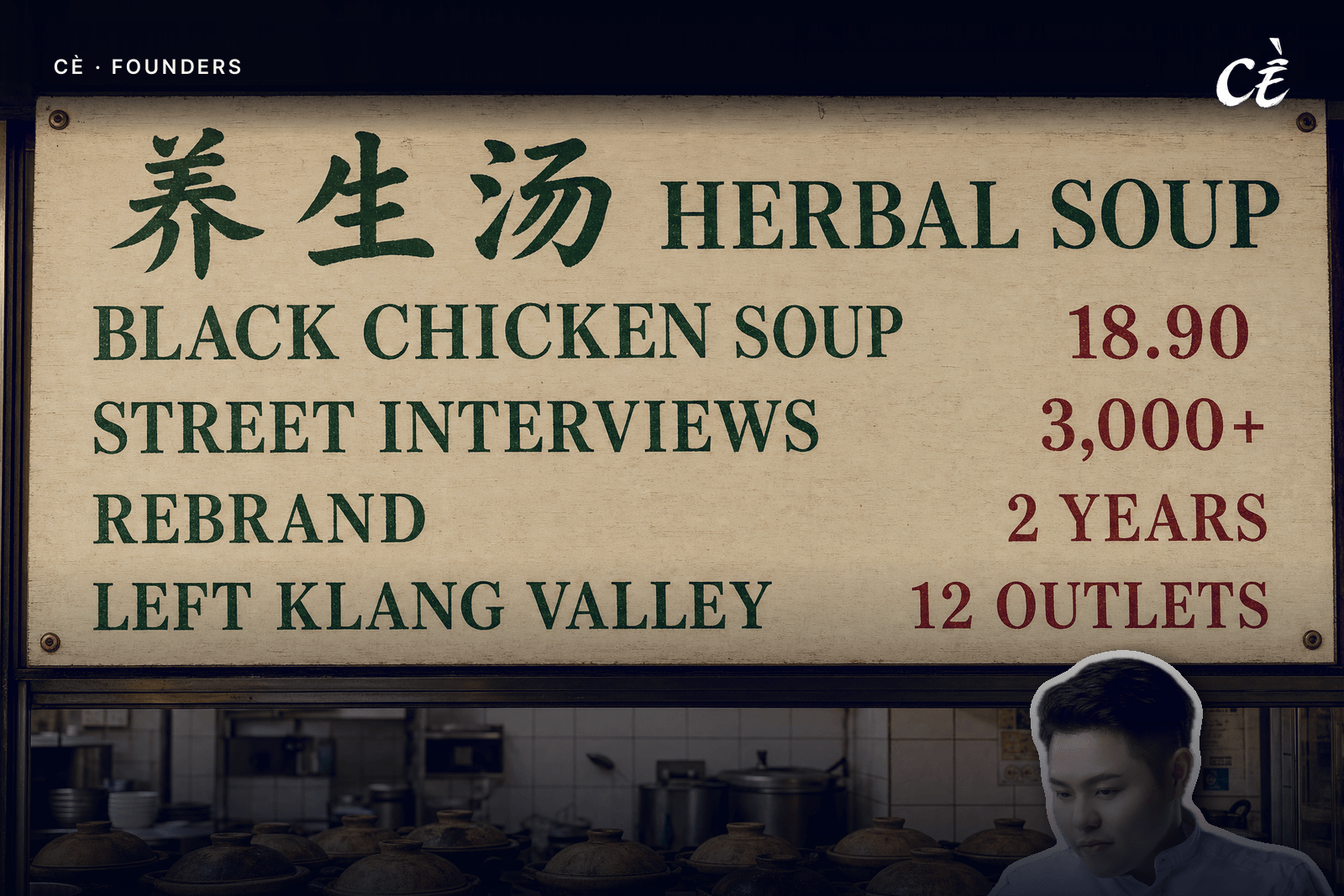
Nevinn Leow joined his parents’ restaurant company in 2012 and decided there were too many herbs in the soup.
Both parents are Chinese physicians. They had run a medical hall offering acupuncture and consultation, and in 2009 they opened a restaurant, because customers kept asking for the herbal soups and had stopped having time to cook them.1
Leow grew up in that hall. He took a bachelor’s degree in accounting and marketing, planned an MBA, and found the programme wanted work experience first.
The work experience became the job.
By 2012 the brand, Taang Shifu, had outlets across Johor Bahru, Melaka, Selangor and Ipoh, and a problem Leow could state exactly. “At that time, half of our soup’s content is filled with herbs. It was too much for everyday consumers.”
Customers read the company as healing rather than as dinner. The name compounded it: read straight off the Chinese characters, Taang Shifu came back as Tongshifu in Cantonese-speaking Ipoh and Selangor, and a brand pronounced differently in every state does not travel.
He tested the instinct before spending on it.
Leow says the company hired an independent market research firm, which spent four months running street interviews across demographics and returned more than 3,000 respondents. He will not name the firm or the fee. The research agreed with him, and he spent the following two years acting on it.
Taang Shifu became Souper Tang in 2015, the first store opening in Mid Valley Megamall.
Then the repositioning started eating the company that had asked for it. Souper Tang wanted family diners, roundtables and private rooms, and fifteen legacy outlets had been built for a different customer at a smaller size.
Over three years Leow took the group out of the Klang Valley altogether, twelve outlets, converting the ones that suited another concept in the group’s portfolio and closing the rest.
“In business, revenue is attractive but given a wrong positioning will tarnish the brand in the long run.”
Asked what he would tell someone inheriting a family brand today, he declined the premise first. He calls it repositioning rather than exiting, and says the company modernised in order to preserve what worked.
Then he gave the rule.
“Know what must never change, and be courageous enough to change almost everything else.”
The test underneath it is the part worth having, because plenty of operators can say the sentence and few can apply it. Leow splits the business in two. Heritage is the nourishment, the recipes, the knowledge inherited from his parents, the quality of the ingredients; expression is the branding, the restaurant design, the menu development, the systems, the technology, and the way the company enters a market.
Heritage is protected. Expression is on the table, permanently.
What keeps the split honest is that he refuses to run it on feel. He describes the test as “a combination of evidence, customer behaviour and a very clear understanding of what the brand ultimately stands for,” which is why the 3,000 respondents came before the two years rather than after them.
He buys his convictions before he acts on them, and pays full price once he has.
The same instinct shows up in who he lets do what. His parents’ knowledge is the asset he names as untouchable, and in Singapore he has handed the operating half of the job to a partner who already runs restaurants there, keeping the brand and the food for headquarters.
The medical hall served the people who already knew to come looking for it.
What replaced it opened in a Raffles City basement on 29 July, in front of a lunch crowd that has never heard of Taang Shifu, which was the whole point of the two years.
Footnotes
-
Leow gave this interview to CÈ’s AI interviewer in August 2026, by voice and in writing. Quotes lightly normalised for print, wording untouched, transcripts on file. He declined to disclose the market research firm or what the research cost; the four-month timeline and the 3,000-respondent figure are his. The brand was recognised in the Malaysia Book of Records in 2019 as the country’s largest soup chain. ↩