
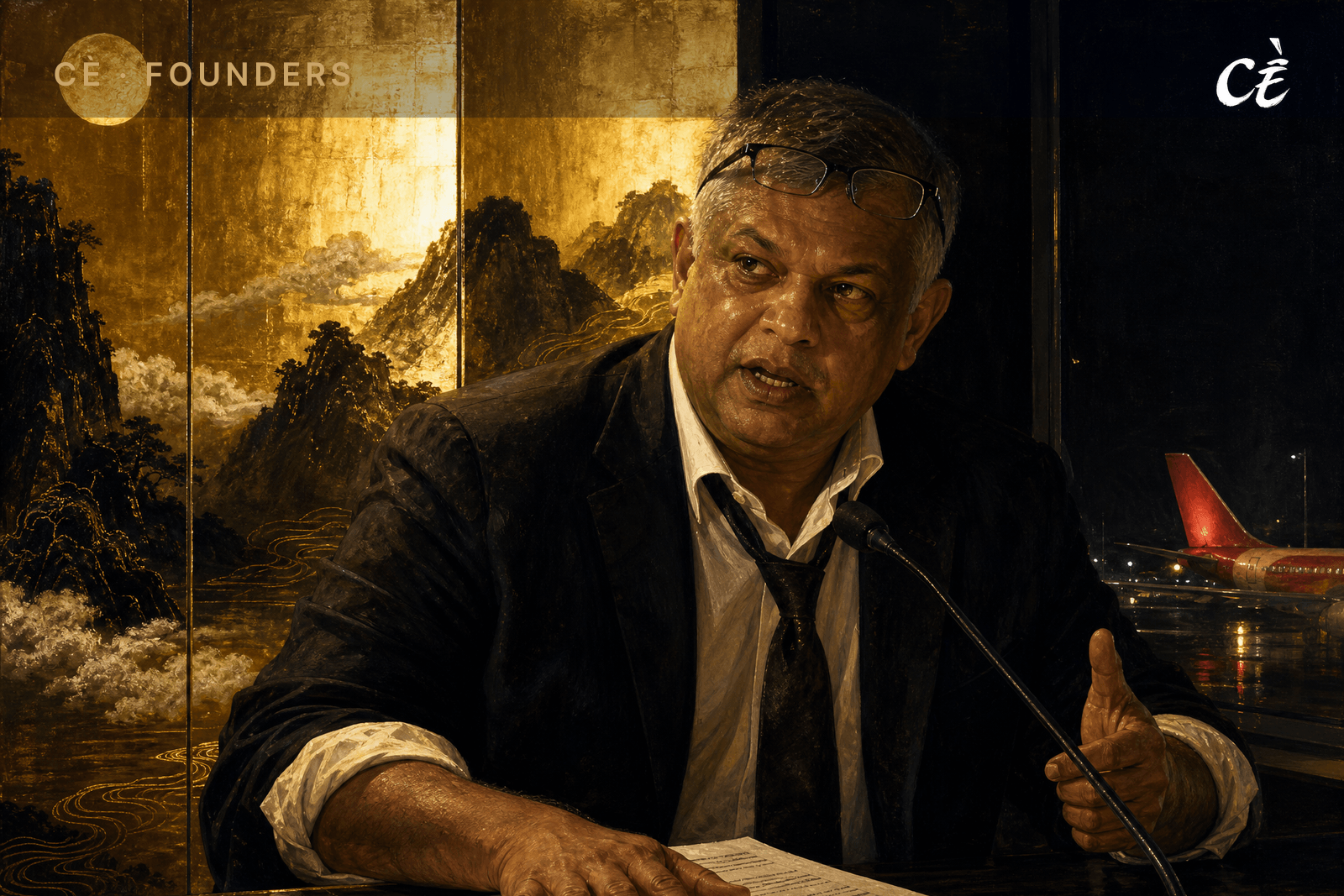
AirAsia lost about US$200 million (RM830 million) in the three months to June, and when a government leak suggested it might need rescuing, its stock fell 21 percent in a single day to a four-year low. Tony Fernandes, who has run the airline for twenty-five years, spent the next two days telling reporters the idea was absurd.
Then he went out and borrowed more than a billion dollars anyway.
In September 2001, Fernandes and his business partner, Kamarudin Meranun, paid one ringgit, about twenty-six US cents, for a government-owned airline flying two ageing Boeing jets and carrying about US$11 million (RM40 million) of debt. Fernandes mortgaged his own house to make the deal close.
A year later the airline had cleared the debt and turned a profit.
The method he used then is the method that shows up in every AirAsia crisis since: take on the debt nobody else wants, keep the equity, and never let anyone dilute him out of the seat.
By June this year the debt was worth far more than one ringgit. AirAsia’s second-quarter net loss of US$200 million came mostly from a jump in jet fuel, which climbed 58 percent to US$183 a barrel, and a US$81 million (RM331 million) foreign-exchange loss. Against US$4.5 billion (RM18.4 billion) of current liabilities, the airline held just US$230 million (RM954 million) in cash.
On 16 September, Reuters reported that Malaysia’s finance ministry and its main airport operator had asked Malaysia Airlines and Batik Air whether they could take over AirAsia’s domestic routes if it came to that. The market did not wait to find out. AirAsia shares fell 21 percent the next day, then another 2 percent the day after.
It’s the most ludicrous statement I have seen in 25 years.
“It’s the most ludicrous statement I have seen in 25 years,” Fernandes told reporters, denying any bailout talks. He said the airline held more than US$250 million (RM1 billion) in cash and called the situation “far, far” less severe than Covid.
He had shed a distress label from the same regulator four months earlier.
Capital A, the listed parent Fernandes built AirAsia into, spent almost six years under Bursa Malaysia’s PN17 rule for financially troubled companies, a status triggered when Covid wiped out its shareholders’ equity in January 2022. It only exited on 20 May 2026, after spinning its airline business into a newly renamed AirAsia Group Berhad and cutting US$1.3 billion (RM5.5 billion) from its books in a court-approved reduction. Five months later, the airline it had just spun off was the one making headlines again.
What Fernandes announced instead of a bailout is worth reading closely. AirAsia is raising up to US$1 billion from international debt markets, plus another US$170 million (RM700 million) locally, and says the money is mostly for refinancing old debt, not funding today’s shortfall.
Reuters had estimated the airline might need at least US$3 billion. Nobody has closed that gap yet, least of all Fernandes.1
While the parent borrowed, the subsidiary raised equity.
On 21 September, AirAsia Philippines closed a deal with a new investor Fernandes declined to name, aimed at funding a fleet expansion of ten to twenty more aircraft, including Airbus A220s arriving from 2028. The unit that is growing got fresh equity. The parent that is bleeding got debt.
Nobody who owns a share of either had to give any of it up.
That split is the whole mechanism, and it travels well past airlines. Any business with one part losing money and another part growing runs into the same arithmetic: a round that covers both prices the growing part at the losing part’s multiple, and asks one investor to solve two different problems at once.
The distressed thing borrows. The thing that works gets fresh money.
Fernandes never lets the conversations merge. The distressed thing borrows. The thing that works gets fresh money, and the founder keeps his seat at both tables.
Within twelve months, AirAsia Group Berhad repeats the split at least once more, funding its next stretch of growth through a subsidiary-level investor rather than a parent-level share sale, because the group’s own stock, down roughly 75 percent since fuel prices spiked with the conflict in the Middle East, is too cheap for Fernandes to sell without losing the company a second time. If Capital A instead raises fresh equity at the group level to close the gap Reuters flagged, the call is wrong, and this column will say so.
Footnotes
-
AirAsia’s own numbers leave the harder question unresolved: Reuters put the airline’s real capital need at roughly US$3 billion against the US$1.2 billion Fernandes has said he is raising, and as of publication neither AirAsia nor Reuters had explained the gap in public. ↩