
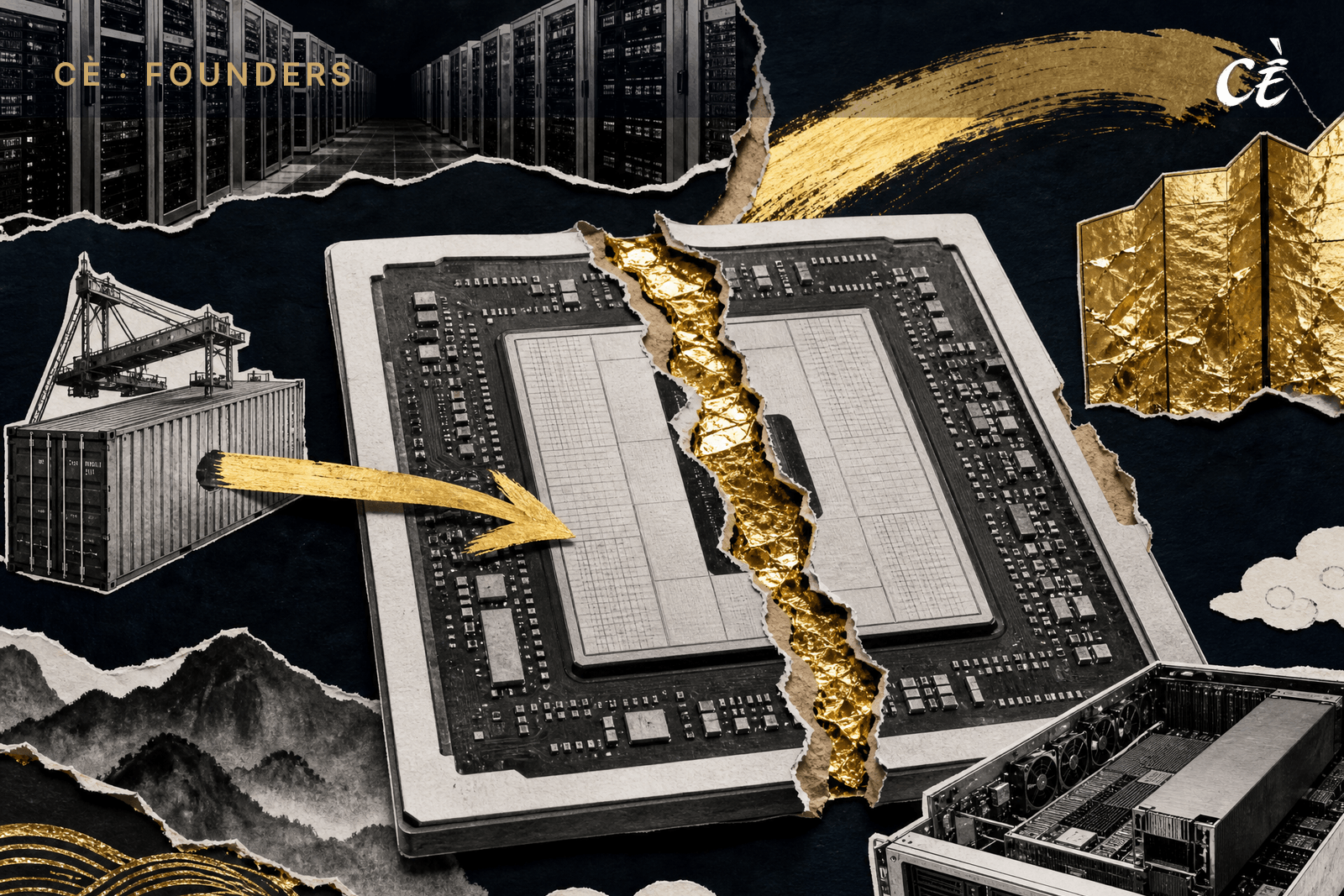
DeepSeek staked its next model on chips made only in China, so Beijing would need Nvidia less. The training run never finished a full pass, and Liang Wenfeng, the fund manager who built DeepSeek, shelved that model with no ship date and put out a plainer one instead. The chips he still relies on remain largely Nvidia’s, reaching him down supply routes now under a US$390 million fraud prosecution in Singapore.
Liang had bet on chips nobody rated before.
In 2020 he spent about US$28 million (RMB200 million) of his hedge fund’s money on 1,100 Nvidia chips, wiring them into a cluster he called Fire-Flyer.1
A year later he built a second one nearly ten times the size, about US$140 million (RMB1 billion) for roughly 10,000 more. A business partner told the Financial Times that Liang was “a very nerdy guy with a terrible hairstyle talking about building a 10,000-chip cluster to train his own models.” Nobody around him believed the chips would ever matter that much.
High-Flyer’s trading profits paid for both clusters, years before Washington restricted the chips at all. By 2023 Liang had turned that hardware into DeepSeek, and by January 2025 its R1 model had rattled markets from Wall Street to Washington.
Beijing wanted the follow-up built on chips it fully controlled, not leased from a country that could ban them tomorrow. So DeepSeek tried training R2, a reasoning model built to work through a hard problem step by step rather than answer at a guess, entirely on Huawei’s Ascend chips, the company’s own answer to Nvidia.
The run never worked. Chip after chip lost contact with its neighbours over the interconnect, the wiring that lets thousands of chips act as one machine during training, and Huawei sent its own engineers to work inside DeepSeek’s offices without fixing it. No clean training pass ever completed, and the launch, planned for May 2025, slipped with no new date.
Liang would not ship a degraded model just to hit a deadline he had already missed.
Instead of forcing the failed bet through, DeepSeek shipped what it actually had. The V4 family, a general-purpose line rather than R2’s reasoning line, rolled out in stages: a preview in April 2026, V4-Pro’s full release that August, a faster V4.1-Flash in September.
DeepSeek built V4 to answer on Huawei’s Ascend chips anyway, even though the model itself had trained the old way, mostly on Nvidia hardware. R2 stayed on the shelf.
The lesson he modelled is blunt. When the flagship bet fails, ship the work that is actually finished, and say so instead of pretending the delay is a plan.
The lesson he modelled is blunt. When the flagship bet fails, ship the work that is actually finished, and say so instead of pretending the delay is a plan.
The ledger is real. A year and a half of Huawei-chip engineering produced no shipped model, R2 still has no date, and the Nvidia hardware running DeepSeek’s training sits downstream of a supply chain now under prosecution. Singapore has charged four people over roughly US$390 million in servers declared for Malaysia that prosecutors say never arrived there, and in July 2026 police seized a US$42 million (S$55 million) mansion tied to the case.
Malaysia’s government has said it will take “necessary action” against any of its own companies found in the chain, though it has not named one.
Liang has answered the failed bet by making it bigger.
This month DeepSeek committed to at least 160,000 of Huawei’s newer Ascend 950DT chips for a training cluster in Inner Mongolia, with first deliveries due between the last quarter of 2026 and the first quarter of 2027. The confidence comes from a smaller trial: about 1,000 Ascend chips finished a lighter, cheaper training pass on V4-Pro in June and held together.
CÈ’s bet: DeepSeek will miss its own early-2027 target on that 160,000-chip cluster and ship its next reasoning model on Nvidia hardware before the Huawei build is proven at full scale.
The call rests on one thing: the interconnect failures that broke R2 live in training a model from nothing, a far harder job than the smaller tune-up run DeepSeek already got working, and Huawei’s tooling will not mature fast enough to close that gap by the first quarter of 2027.
The nerdy guy with the bad haircut is still buying clusters nobody thinks will work. Some of them, eventually, do.
The nerdy guy with the bad haircut is still buying clusters nobody thinks will work. Some of them, eventually, do.
Footnotes
-
DeepSeek itself has never taken an outside funding round; Liang owns about 84 percent of it personally, with the rest held by people tied to High-Flyer. ↩