
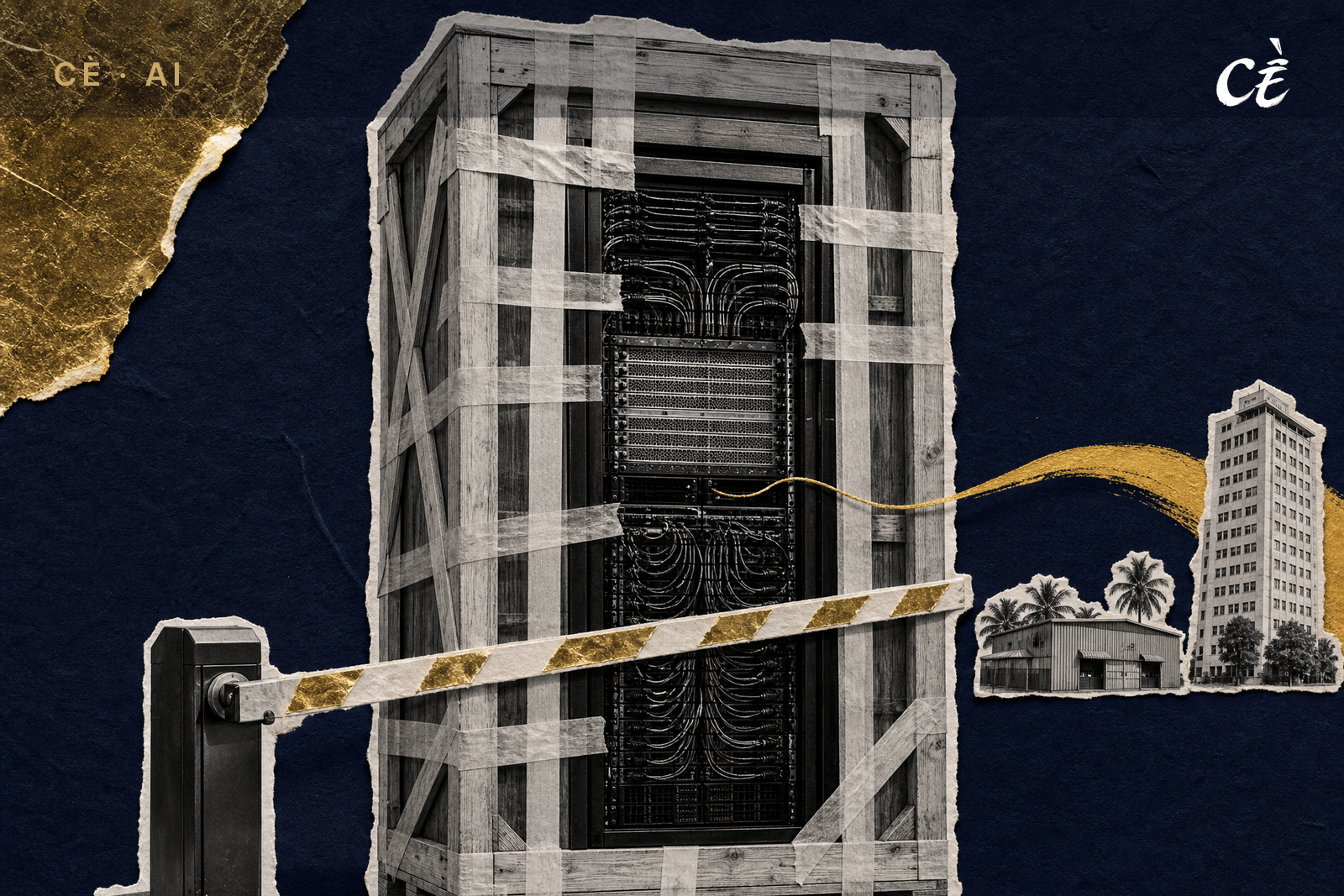
The chips never left the country. The training run did.
On 22 July, Michael Kratsios, who runs the White House Office of Science and Technology Policy, said Moonshot AI had acquired servers carrying Nvidia’s GB300 and had reached more of them inside Thailand, most likely to train its models. Seven weeks earlier, Commerce had told exporters that an advanced Nvidia part sold to any company whose ultimate parent sits in China needs a licence, wherever the buyer happens to be registered.
Both things are true, and nothing between them required a smuggler.
American export law governs a thing crossing a border. It has never governed the use of a thing that stays where it is. The Bureau of Industry and Security said so in an advisory opinion in 2009, said it again in 2011, and said it a third time in 2014: a cloud provider that lets a foreign customer run work on controlled hardware has not exported the hardware.
The export happens when the password crosses the border. The compute never moves.
The export happens when the password crosses the border. The compute never moves.
Those opinions were written when renting a computer meant renting a filing cabinet with a fan in it. They are now the operating manual for the frontier.
So a Chinese lab that cannot buy an Nvidia rack books hours on one standing in a shed outside Bangkok, or in Johor, or outside Osaka. The rack keeps its Thai owner, its Thai power bill and its Thai tax residency. The weights that come off it have a Beijing address.
Britain spent the Napoleonic wars trying to keep neutral shipping out of the French colonial trade. The Rule of 1756 let a neutral trade with a belligerent and forbade it to trade for one, which sounds like a rule right up to the moment a cargo has to be classified.
American captains found the seam. Load Havana sugar, land it at Charleston, pay the duty, re-export it to Spain, and one voyage has become two, both of them lawful.
The Admiralty court blessed the arrangement in the case of the Polly in 1800. American re-export trade went from 40 million dollars that year to 60 million by 1805.
Nobody smuggled anything. The itinerary did the work.
Nobody smuggled anything. The itinerary did the work.
Britain’s answer took five years and no legislation at all. On 22 May 1805 the Lords Commissioners of Appeals took up the Essex, carrying French colonial goods through an American port, and held that the stop had interrupted nothing.
Same statute, same rule, new reading, and roughly fifteen hundred American ships taken in the years that followed.
Washington is at the Polly stage and knows it. The House passed the Remote Access Security Act on 12 January by 369 votes to 22, a bill that would let Commerce license remote access to controlled items the way it licenses a shipment. The Senate companion has sat in the Banking Committee since December with no floor vote.
Three hundred and sixty-nine to twenty-two, and eight months of nothing.
The party with no exit here is the White House. Its own science director stood up in July and named a Chinese lab, a specific Nvidia part and a country, which turns a drafting gap into a public one. An administration that has said out loud what is happening cannot leave the thing lawful and hope the subject changes.
Count what each player has left. Congress is out of calendar, and Commerce is out of doctrine, having spent seventeen years assuring industry of the opposite.
Nvidia and the American clouds book real revenue on the rental and will price any rule that touches it. Southeast Asia is the floor the whole arrangement stands on, and the only party in the argument with nobody to lobby.
The region has already had its warning shot. In May, American officials flagged a Bangkok firm for moving Nvidia servers to Chinese customers, and the same month Commerce moved the test from where a buyer is registered to who ultimately owns it.
That shifts the work of verification onto regulators in Kuala Lumpur, Bangkok and Jakarta who have to trace ownership through layered holding companies, and who do not have the staff.
The rule will arrive before the statute. Expect Commerce to publish a licence requirement covering remote access by Chinese entities to controlled AI hardware held abroad, and to do it by rule rather than wait for a Senate calendar it does not control, by the end of May 2027: after the November tariff-and-minerals expiry forces the administration to settle its China posture, and inside the window before the next Congress would have to start the bill again.
The call rests on one thing. Washington has to want the training run stopped more than it wants the rental revenue Nvidia and the American clouds earn from it, and that trade has already been lost once, when the AI Diffusion Rule of January 2025 was rescinded in July of the same year after the same argument from the same firms.
The signal comes earlier than the rule, and it is cheap to watch. The tell is the first data-centre operator in Thailand, Malaysia or Japan added to the Entity List, rather than another Chinese lab.
Naming the landlord means the rule is already drafted.
Southeast Asia sold the world a landlord’s business: floor space, power, cooling, and the comfortable understanding that a landlord is not required to know what the tenant is building. That understanding ended for the shipowners of Salem and Charleston on a May morning in 1805, and it did not end with a new law.
The rack will stay exactly where it is. The only question left is who has to know what it is doing.