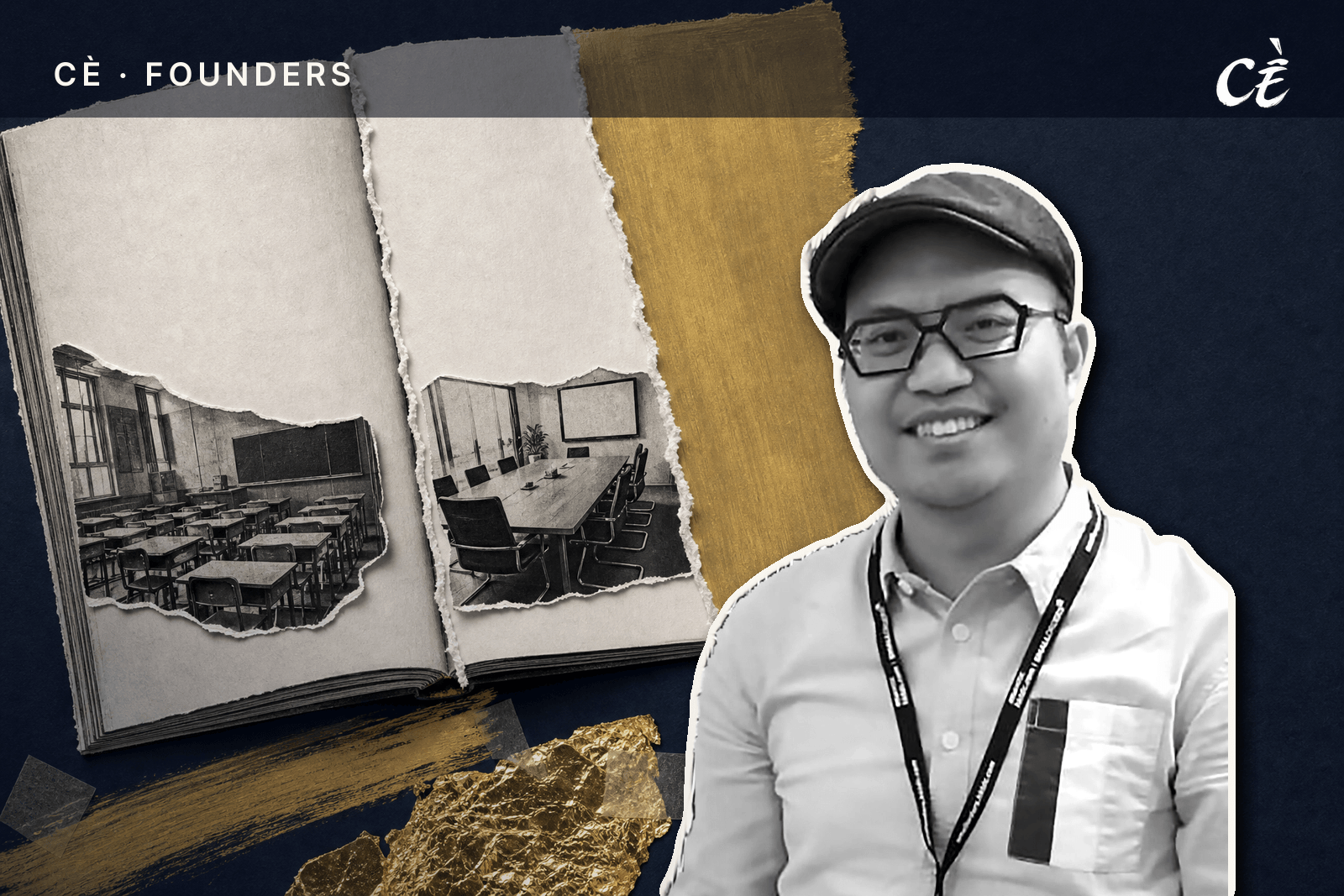
Ah Lok’s week has run on the same split since 2017: a third teaching classes, a third on client commissions, a third on picture books nobody has paid him to make.
The third that earns nothing is the one he defends. He turns down paid work when the calendar fills, which means the reservation is a standing price he pays rather than a preference he expresses.
He signs that work Nalok Lok, a name built out of two words: naraka, the Buddhist hell, and lok, happiness in Cantonese. The books are about the second thing found inside the first.
Ah Lok took a Master of Design at Hong Kong Polytechnic University, then a scholarship to study visual arts at the art academy in Latvia, where a course on picture-book production returned him to drawing after seven years away from it. His first book, Scarecore and Bird, went straight onto Facebook, Instagram, and platforms in Taiwan and mainland China. Commissions and teaching enquiries arrived about six months later, and he said yes to both.
The Japan Illustrators’ Association has since named him twice, including Illustrator of the Year in 2023, and he collaborates with Wacom.
Then the work got too heavy and readers left without saying so.
Ah Lok describes early stories whose dark, niche positioning made some prospective clients hesitate. No client told him why. What he noticed was quieter: “a few people who had been interested simply stopped reading and left.”
He declines to name the book, and points instead at the correction, which is a rule he can state and apply.
“Show the story, not the raw suffering.” The subject keeps their dignity; the viewer is left able to act rather than frozen. He adds a second line under it: he never uses pain as pure spectacle, showing only enough of the difficulty for the meaning to land.
The clearest instance is a donation film he made for the Sheng Kung Hui Holy Carpenter Church, whose hospice and bereavement service helps bereaved families through funeral arrangements. He proposed telling one family’s story in full rather than surveying the need.
I chose not to show grieving faces, open tears, or any graphic or overly dramatic images of poverty or death, so as not to treat the families as objects of pity.
“I chose not to show grieving faces, open tears, or any graphic or overly dramatic images of poverty or death, so as not to treat the families as objects of pity.”
He now runs a three-question test before publishing anything, the first of which asks whether a reader still has room to breathe afterward.
He also shows the work to a few people he trusts to be sensitive to weight, and reopens it when they say it feels too closed.
The most expensive drawing he has made is the cover of My Forbidden Room, a picture of a room holding the objects from his past that once hurt him. He finished it and understood something about himself he had not known before starting.
That is the part of the practice with no invoice attached to it. Every image drawn from something he has not yet processed requires him to sit with the feeling first, which is slower than working in lighter subjects and leaves him raw for a while afterward.
If I skip that inner work, the illustration becomes empty. Readers can feel the difference.
“If I skip that inner work, the illustration becomes empty. Readers can feel the difference.”
Which is the argument for the third of the week that pays nothing, made in the only currency the studio actually runs on.1
Footnotes
-
Ah Lok gave this interview to CÈ’s AI interviewer over text, completing it on 2 August 2026. Quotes lightly normalised for print, wording untouched, transcripts on file. He declined to discuss his rates. ↩