
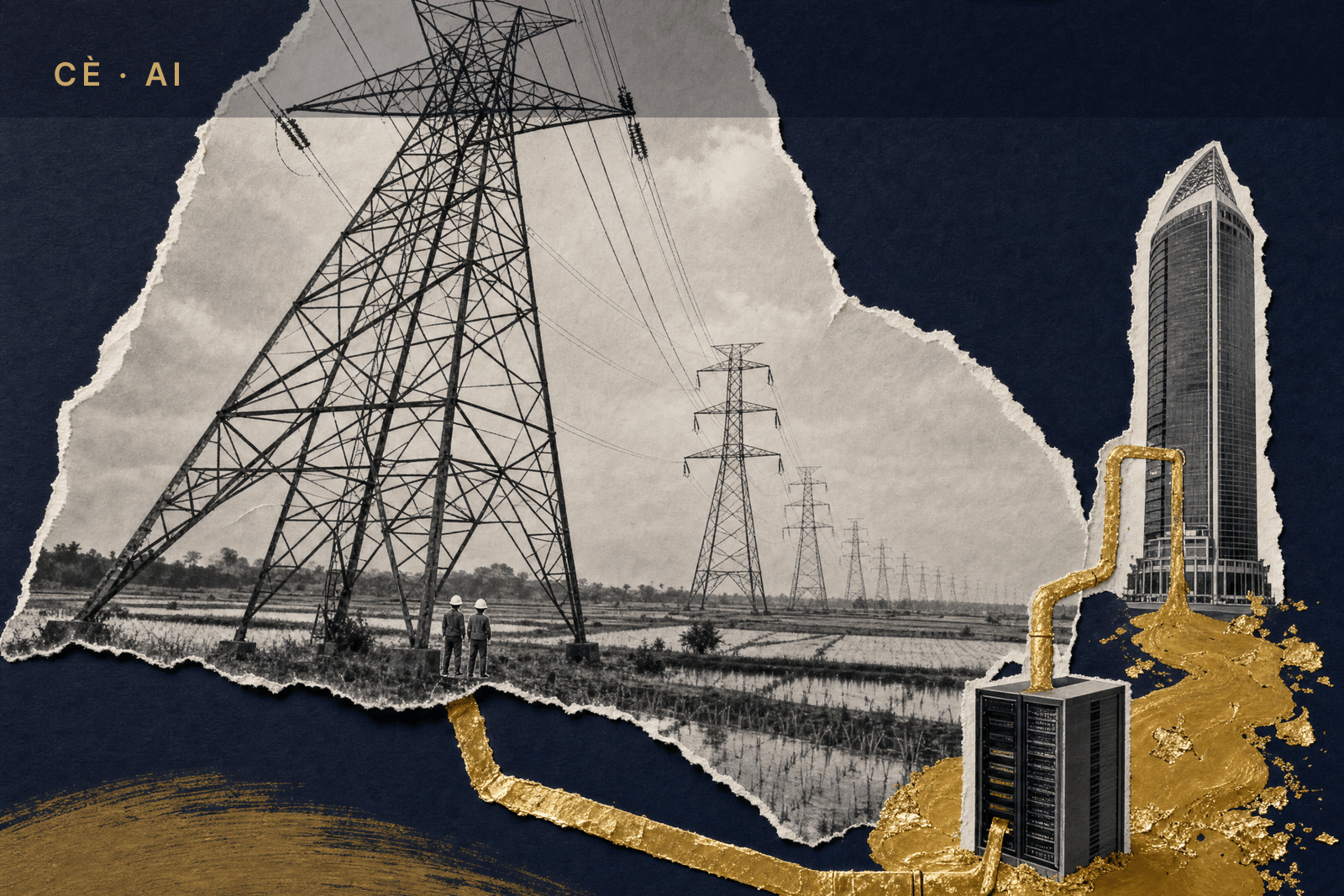
A gigawatt of AI compute is landing in Indonesia. The largest data centres in the United States employ fewer than 150 permanent people each, and some run on 25.
Those two facts were published within days of each other, and only one of them made the regional press.
Indosat Ooredoo Hutchison launched Zankore on 7 August with Ooredoo Group, Nokia and NVIDIA. The platform targets a gigawatt of NVIDIA DSX capacity, with roughly 200 megawatts live in the first half of 2027 on GB300 NVL72 systems. Jakarta is the first deployment market, and the stack runs local models, Sahabat-AI among them.
That is the announcement. The terms are more interesting than the announcement.
Ooredoo put in about US$800 million over five years and took 49 percent as founding shareholder. The platform’s own forecast, given to Fortune, is roughly US$13 billion of revenue and US$9 billion of cumulative EBITDA across those five years, of which Ooredoo expects around US$600 million in proportionate EBITDA. Ooredoo’s group chief, Fakhroo, described the tenanting approach as cherry-picking by balance sheet, with demand already running past the first 200 megawatts.
Read that as a lease and it resolves. Doha brings the capital, Santa Clara brings the silicon and books the margin on it, Espoo brings the network layer. Indonesia brings land, grid, water, permits and local execution, and takes 51 percent of a platform whose scarcest input it is also selling.
The gigawatt is the headline. The equity split is the deal.
The gigawatt is the headline. The equity split is the deal.
This is where the WRI number does its work. A review of more than 1,200 American data centres found the largest employing under 150 permanent staff. An AI campus is not a factory that happens to hold servers; it is a substation with a roof, and the labour lands in the two years of construction rather than in the thirty years of operation.
The input side is where the regional cost shows up. Ember puts Malaysian data-centre power demand at 8.5 TWh in 2024 and 68 TWh by 2030, close to 30 percent of the country’s electricity. Malaysia has already frozen non-AI data-centre development over water and power, while DayOne alone committed US$3.5 billion in Johor last year.1
Cheap local compute is a real gift to a Jakarta operator, and it is a gift with every competitor’s name on the card.
So a Jakarta or Singapore operator should price this the way they price diesel or bandwidth: as an input.
Compute becoming local, plentiful and cheaper is a genuine gift, in the same way cheap electricity was a genuine gift to a factory in 1960. Plan the next two budget cycles around inference costs falling, and plan for nobody in the sector holding an advantage because of it, because the same 200 megawatts will serve every competitor with a purchase order.
The number worth writing down is US$13 billion over five years. That is the counterparty’s own estimate of what the arrangement is worth, and it is the only figure in the announcement anyone has been asked to stand behind.
Malaysia’s moratorium on non-AI data centres is the region trying to write itself back into a contract it has already signed. A freeze on the low-value tenants leaves the high-value ones exactly where they were.
A gigawatt is still worth having, and the cheap inference that comes with it is real. The thing to remember at year five is that Indonesia’s return was agreed in August 2026, in public, at 51 percent of a platform it will spend three decades powering.
Footnotes
-
The strongest argument against all of this is a port. Container terminals employ almost nobody per dollar of throughput, and Singapore built a country on one, so headcount may simply be the wrong yardstick for infrastructure whose value is proximity. ↩