
Zeno of Citium was a merchant before he was a philosopher, and the sea took his stock in trade. Somewhere off the Piraeus, around 312 BC, a ship carrying his Phoenician purple went down; the dye was worth roughly its weight in silver, and it coloured the Aegean instead.
Zeno walked into Athens with nothing left to sell, sat down in a bookshop, and read Xenophon on Socrates until he had to ask the bookseller where men like that could be found. The bookseller pointed at Crates the Cynic, passing in the street.
The school Zeno went on to found had a posture for this, and Nietzsche later gave it the name that stuck: amor fati, love of fate. The modern version is an accounting move. You take the thing you did not choose and re-book it, deliberately, as material.
In December 2025 a co-founder walked out of Jane Ng’s Taiwan e-commerce company, and the exit made a mess that took her a month to settle. She had spent that year as the venture’s forward face, investor relations included, groundwork that suddenly had no company underneath it.
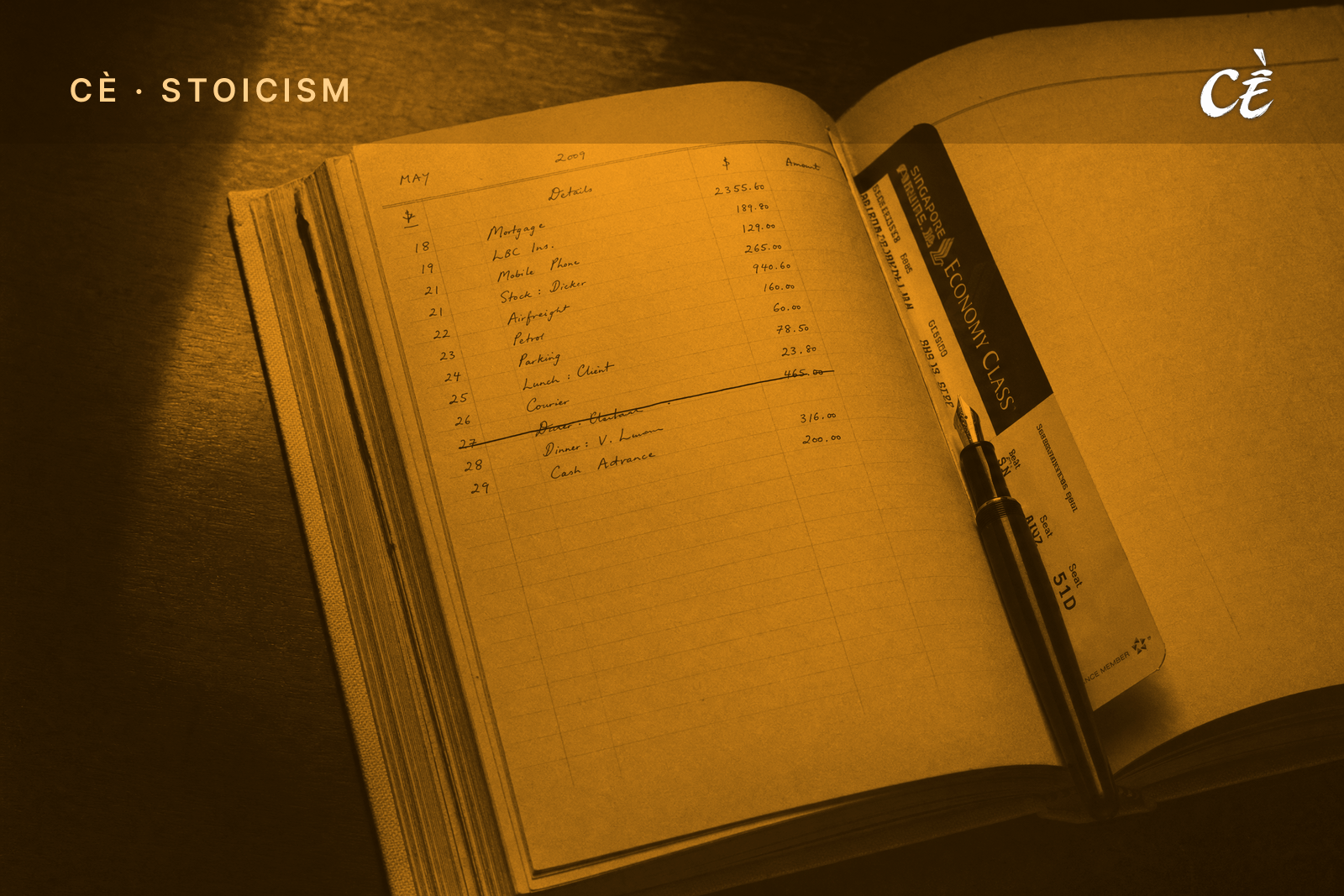
She stepped away, came home to Singapore, and did the books on the year. Her entry, in her own words: she “zeroised the COST part and balanced it off as LEARNING.”1
The move deserves respect precisely because it is bookkeeping rather than therapy, and bookkeeping has rules. First you recognise the loss in full, at its real size. She itemised hers before zeroing anything: patience, reputation and pride sit on the list next to the year of work.
Then you decide what the remaining asset is. Zeno’s was his own attention, freed of cargo. Ng’s was a sharpened rule about whom she builds with, priced at one company.
Amor fati has a cost of admission: you pay the loss at face value first.
Founders who skip the first step and jump straight to gratitude are doing something else, closer to denial with better posture. Amor fati has a cost of admission: you pay the loss at face value first.
Marcus Aurelius, who ran an empire on this discipline, kept an image for it: a strong fire makes flame and brightness out of whatever is thrown on it. What gets thrown is fate’s choice. The fire is yours, and it is the only part of the transaction you were ever going to control.
What she told the interviewer next is the working half of the philosophy. In the weeks after the exit she decided she “had to trust the process be it positive or negative,” and let the people who could not match her fall away.
Zeno had no cap table. He had the same December: a concentrated position, a partner called the weather, and a total loss he did not choose. The instrument changes; the write-down is identical.
I made a prosperous voyage when I suffered shipwreck.
Two months after her December, Ng met the partner she would build CÈ Media with. Two decades after his, Zeno was teaching at the Stoa Poikile a school he could only have started because the cargo sank, and he gave the wreck its final entry: “I made a prosperous voyage when I suffered shipwreck.”
Footnotes
-
The Zeno account is Diogenes Laertius, Lives of Eminent Philosophers, book seven. Disclosure: Ng co-founded CÈ Media, the publication carrying this essay; her quotes are from her interview with CÈ’s AI interviewer, compiled in the founders section, and the transcript is the audit trail. ↩