
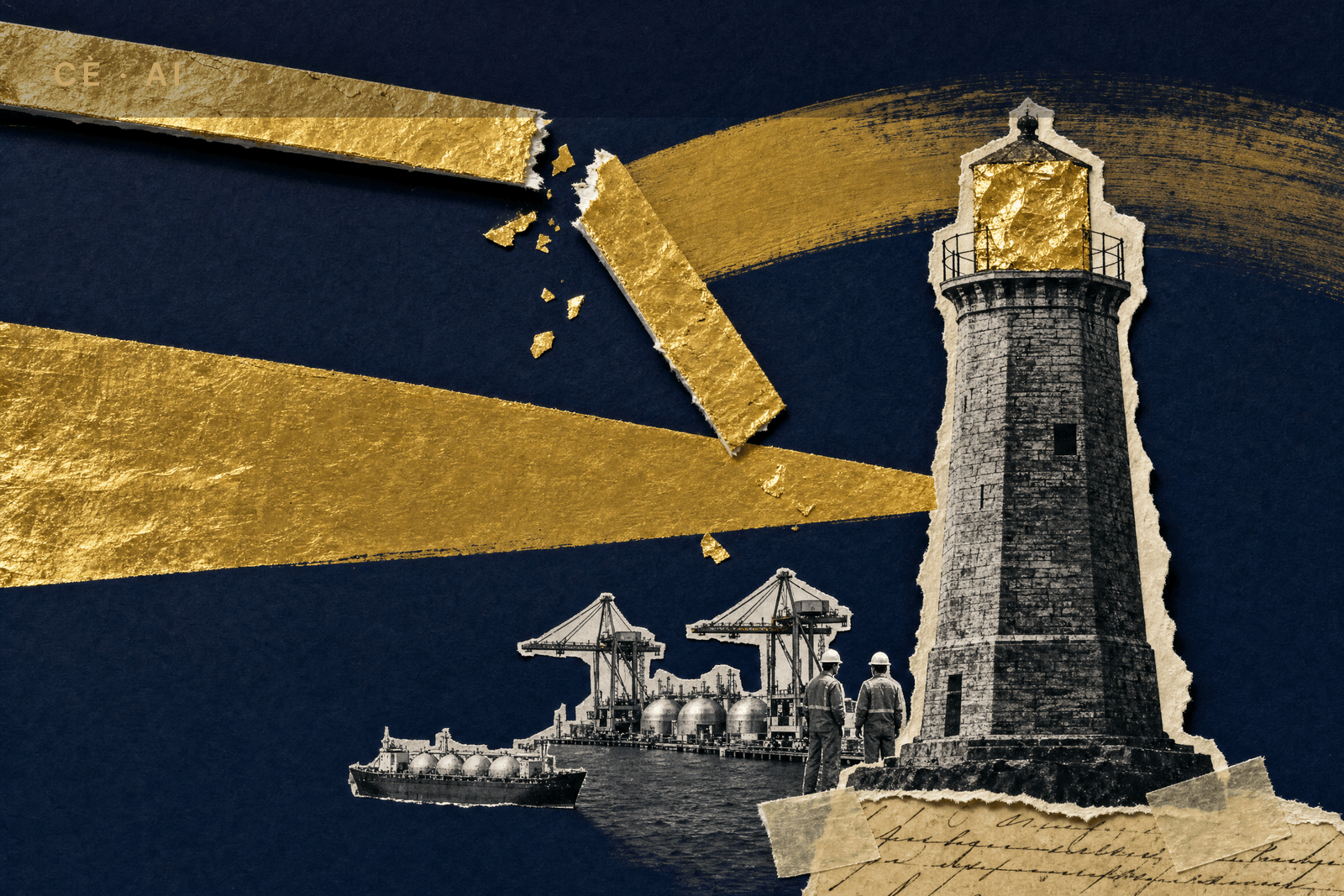
It costs $6.70 a ton to cross the Bosphorus, up 14.9 percent since 1 July.
The money buys health inspection, lighthouse service and salvage cover, and Turkey took $223 million of it in the year to June 2025, against $38 million three years before.
No shipowner association wrote to the United Nations.
Twelve days after that rise, Washington announced a 20 percent charge on every cargo crossing the Strait of Hormuz and withdrew it inside about a day, swapping it for unspecified Gulf trade and investment deals while the naval blockade ran on.
Two charges levied on a strait, a fortnight apart. The one still being paid is the older, smaller, duller one.
The gap between them is legal form, and legal form is doing more work in this war than any warship.
That form is now being priced in Muscat. Iran and Oman have agreed the coordinates of a route through the strait, with ships entering the Gulf through a northern lane in Iranian water and leaving through a southern lane along the Omani coast, run from a joint coordination centre. Reuters reports the two governments negotiating a charge of 3 to 7 percent of declared cargo value, Tehran pressing for 5 to 7, Muscat offering 3.
At 7 percent on pre-war volumes, that is about $385 million a day.
More than $100 billion a year, past the Suez Canal’s best year, worth over a third of Iranian GDP, with not one extra barrel pumped to earn it. A single very large crude carrier with two million barrels aboard would hand over some $11 million to make one crossing.
Eight shipowner bodies, among them BIMCO, the International Chamber of Shipping and the Asian Shipowners Association, have written to the United Nations to oppose it.
Turkey settled this question in 1936 and has been collecting ever since.
The Montreux Convention, signed on 20 July that year, abolished the international commission that had governed the Bosphorus and the Dardanelles since Lausanne and handed full military control of both back to Ankara. Then it did the thing that made the arrangement last ninety years.
Article 2 bars Turkish authorities from levying any charge on a ship in transit beyond the three listed in Annex I, priced in gold francs per net register ton: sanitary control at 0.075, lighthouses and channel buoys, life-saving stations. Pilotage and towage stay optional. A ship that does not call at a Turkish port pays for those services and nothing else.
Ankara has multiplied the gold franc more than eight times since 2022, from the $0.80 it had held flat since 1983. The ships keep paying, because every franc of it answers to a lamp, an inspection or a lifeboat.
The law of the sea says the same thing in fewer words. A coastal state may not tax transit passage through an international strait, and may charge for services it performs.
So the pricing base is the argument, and the percentage is a detail.
No lighthouse burns more oil when the boxes beneath it are worth more.
A charge assessed on the declared value of the cargo cannot be a service fee. No lighthouse burns more oil when the boxes beneath it are worth more.
Tonnage measures the ship. Value measures the owner’s capacity to pay, which is the definition of rent.
Tehran and Muscat appear to have worked this out at the table. The same Reuters reporting has traffic moving to a central corridor after a transitional phase, with charges then structured around services rendered instead of a share of cargo value.
The forecast follows from the base rather than from the politics.
By 6 August 2027, no ad-valorem charge on Hormuz transits, no percentage of cargo value, will be in force and routinely paid. Whatever Iran and Oman end up collecting will be billed the way Ankara bills, per ton or per transit, against named services. Likely, at 0.75.
The load-bearing assumption is that the free-transit norm still sets the price of this strait. If lifting the American blockade is traded for Washington’s blessing on a percentage cut, or if Tehran collects at gunpoint from control of the inbound lane, the call breaks and legitimacy turns out to have been decoration.
The column owes an honest note against its own book.
This column holds an older Hormuz forecast, made in June, that the strait would see no multi-week near-total closure before June 2027. Eight crossings on a Monday against a pre-war 130 a day is not a comfortable number to hold it against, and the closing hand is an American blockade the forecast never named. That one gets graded when it matures, and graded honestly.
Southeast Asia has the largest stake in how the charge is written and the smallest voice in writing it.
Around 80 percent of the crude and close to 90 percent of the LNG crossing Hormuz is bound for Asia. Singapore generates 95 percent of its power from gas, Indonesia holds twenty-one to twenty-three days of oil reserves, and the Philippines draws 95 to 98 percent of its crude from the Gulf. Asian refiners have already cut 3.5 million barrels a day, about 12 percent of their runs.
None of those countries can escort a tanker.
The eight associations now at the United Nations are the nearest thing this decade has to the buyers’ pool that once combined to purchase a strait outright, and what they have pooled is a sentence rather than a treasury. The sentence says a lighthouse may be billed and a passage may not.
That is what a chokepoint is worth once it is rented out as a service instead of held as a hostage.
Turkey’s lamp on the Bosphorus earns $223 million a year and has never needed defending. That is what a chokepoint is worth once it is rented out as a service instead of held as a hostage.