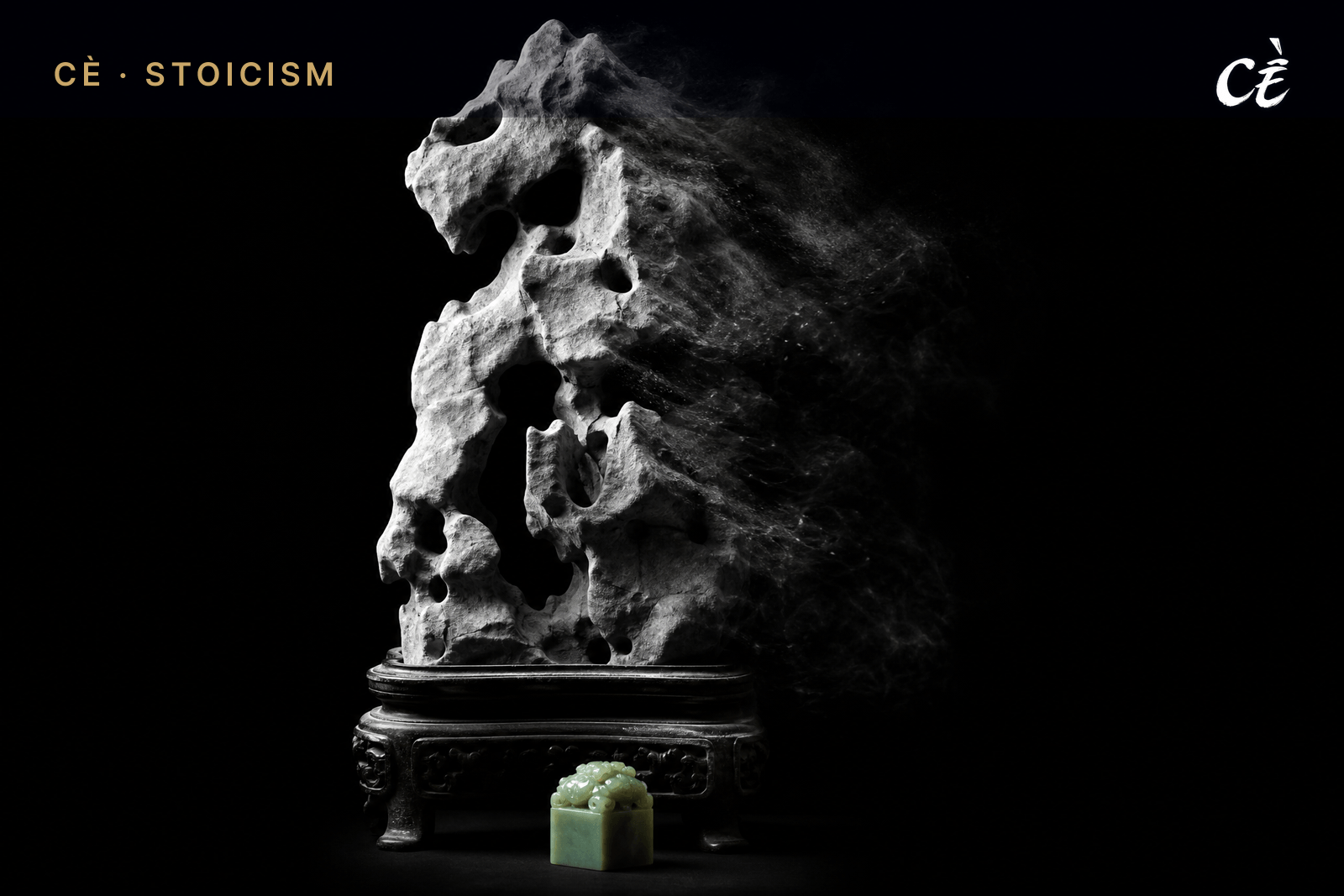
Marcus Aurelius had a trick he ran on himself when the news from the front was bad. He would picture himself rising: above the camp, above the Danube, above the whole empire he was failing to hold, until the legions looked like ants hauling grain and his own name meant nothing at all. From that height, he wrote, you could finally see the thing for what it was.
He called it the view from above. He did not invent it. The Stoics before him had used the same move for three hundred years, and he borrowed it the way a tired man borrows a chair.
It works on two axes. You pull back in space, the office to the city to the small blue planet, and you pull back in time, this quarter to this decade to the hundred years after you are dead and no one alive remembers the deal. Either axis shrinks the threat to its real size. Both together can make a catastrophe look like weather.
A founder in Singapore spent a recent weekend watching a status page. The model her company had built its entire workflow on had been switched off on a Friday by an export order written in another country, and she refreshed the page through Saturday and into Sunday as if attention were a form of repair. By Sunday night the page had not changed and she had not slept. She had no email Marcus did not have. She had the same problem he did.
The view from above is scale correction. Most of what feels like the end of a company is a problem that has been viewed from too close, for too long, by someone who has not stood up from the desk.
The trap is to mistake the altitude for an excuse. Zoom out far enough and nothing matters, the macro essayists will happily take you there, the empire falls anyway and the sun eventually swallows the Earth. But that is the anesthetic version. Marcus climbed in order to come back down clearer, to return to the war with the panic burned off, not to talk himself out of fighting it. The height was a tool for acting, used by a man who could not afford to stop.
From high enough, the thing that felt like the end of the world is a Tuesday.
From ground level, the founder’s weekend was a disaster: the best model in the world, gone, her product hollowed out overnight. From altitude it was duller and more useful. A single supplier had failed, the way single suppliers do, and named a dependency she could now go and fix. From high enough, the thing that felt like the end of the world is a Tuesday.
She got larger in relation to it.
The threat did not get smaller. She got larger in relation to it.
The same correction works on a down-round, on the silent week between two board meetings, on the Monday that arrives wearing the face of an ending. None of them is smaller than it feels at the desk. You are the thing that changes size.
Marcus wrote his way up to that height most nights, in a tent, by lamplight, in a language not his first, while losing. He left one instruction for getting there that has not aged. Survey the circling stars, he wrote, as though you were running their course with them.