
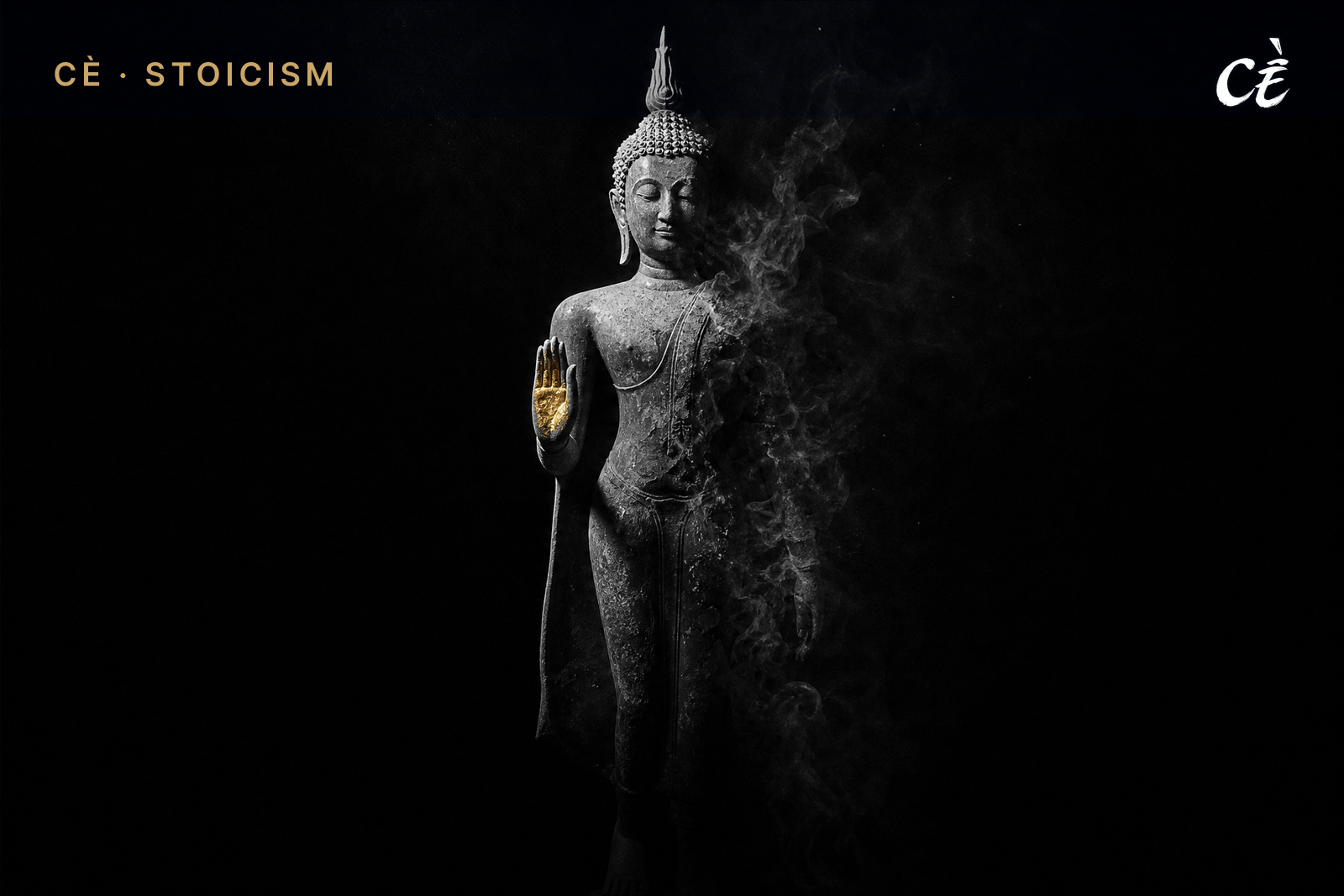
Seneca, who at the height of his stewardship of Nero held an estate the historians later estimated at three hundred million sesterces, set aside three days a month to live on dry bread and a hard pallet. He drank water. He did this in a country house outside Rome, at intervals he tracked, when no one was looking. The Stoics called the practice voluntary discomfort.
He did not believe it would prevent poverty. He believed it would settle the question of whether poverty, when it arrived, was the thing he had been afraid of.
The 2026 version, on a Friday at noon. A founder, fifty people on the payroll, an office on the upper half of a Tanjong Pagar tower, opens the MTI Q1 release at her desk. The headline is fine: 4.6 percent year on year. The numbers she keeps are buried inside the document. The economy contracted 0.3 percent quarter on quarter, manufacturing slowed from 11.4 to 5, two of her three largest customers have paused renewals into Q3. She does not draft an internal memo. She does not call her cofounder. For the next two weeks the corporate American Express stays in the drawer, she takes the MRT to client meetings, and she buys her own kopi.
That is the practice Seneca was running. Measurement, in the form he could afford.
Comfort accumulates without being seen. The founder counts the Marina Bay dinners and the business-class upgrades; those, she sees. What she does not count is the Grab booked three blocks from the office because the heat is on, the second flat white of the morning bought because the kopi-O queue was a minute longer, the corporate-card receipt auto-reconciled by an accountant who has never met her. In a growing market the total absorbs. In the market the May 16 release describes, the same total is two months of an analyst’s payroll.
The version that does the work is the one no one sees.
The discipline of the practice is its privacy. A poverty week run for the team is a leadership exercise; a poverty week posted on LinkedIn is something else, and Seneca, who exchanged letters with Lucilius and stored them, would have recognised the genre and laughed at it from inside his own contradiction. The version that does the work is the one no one sees.
She has Seneca’s problem and none of his stage. She is the wealthiest she has been in her working life, the last round’s compensation tail has cleared, the household is comfortable in the specific way Singapore households become comfortable around year four of a successful company, and the cost of that comfort is that the bad quarter, when it lands, will land against an unmeasured baseline. The two-week practice is the cheap version of the test the next quarter may be preparing to run for her.
She has Seneca’s problem and none of his stage.
She returns on the third Monday. She signs the renewal that paused, books a Grab to Boon Lay because the meeting starts in forty minutes, walks past the kopitiam she has been eating at without looking in. The card is back in her wallet. The notebook stays in the drawer with one closed file, dated, and one column of numbers she did not have a fortnight ago.
Set aside, Seneca wrote to Lucilius, a certain number of days during which you shall be content with the scantiest fare, with coarse and rough dress, saying to yourself: is this the condition that I feared?[^1]
[^1]: The letter is Epistle 18, written from a Campanian villa the week before Saturnalia. The wealthiest Roman of his generation, in writing it, was advising a junior magistrate to practise poverty. The hypocrisy is in the record. The practice survives it.