A flour-mix and coffee producer in Vietnam had never imported anything directly. Everything arrived door to door, in small lots, at the price the door charged.
Phạm Thị Hương Giang, who works as Jang Kều, was months out of a master’s in international business and finance in Korea and running the Vietnam operation of an American flavour and fragrance house. She had no technical background and a staff who knew the products better than she did.1
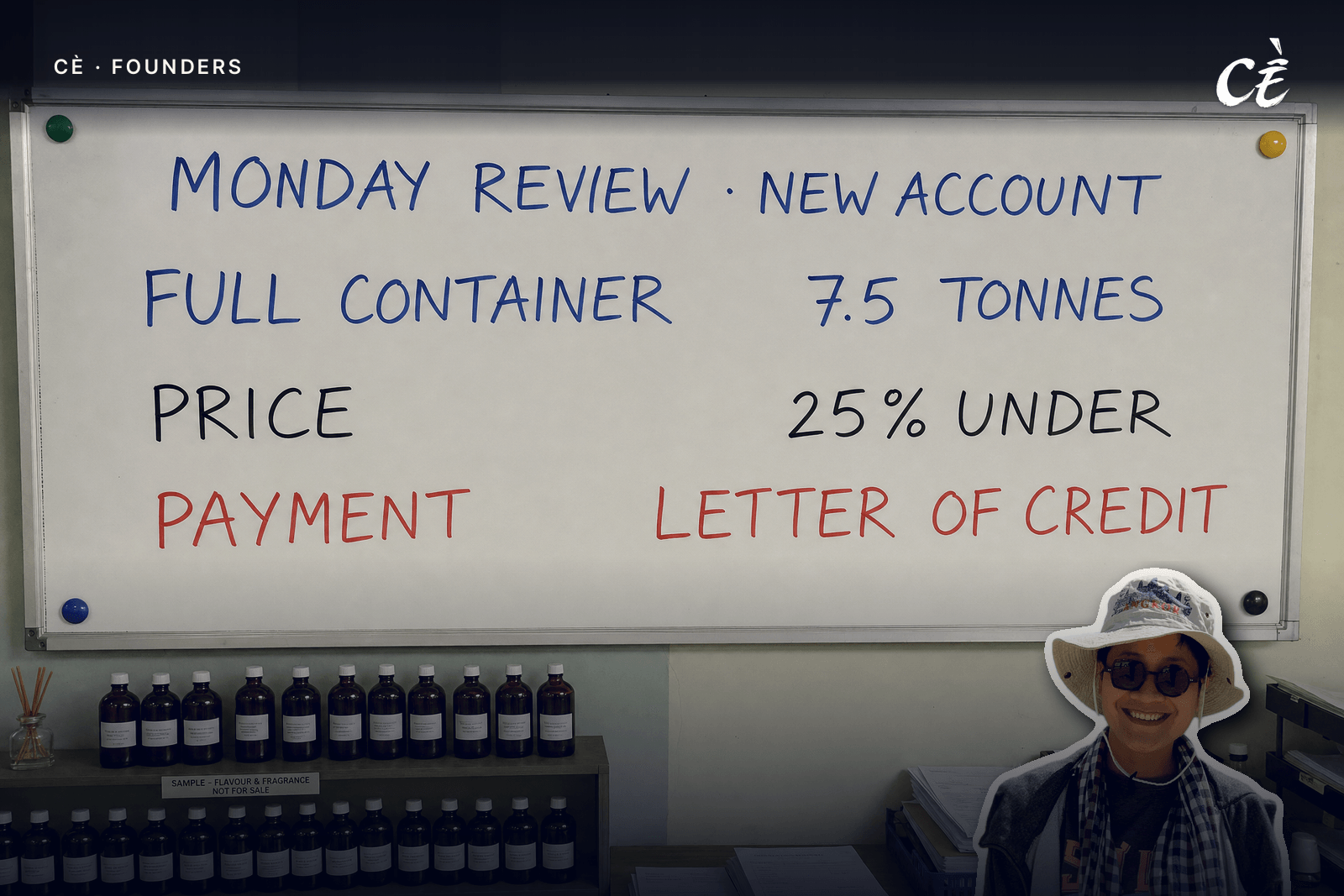
She watched the producer’s orders climb, then offered a full 7.5-tonne container at 25 percent below what they were paying.
The owner liked the number and had no idea how to buy that way. Letters of credit, bank procedure, the shipping paperwork: none of it was work Jang Kều knew either.
So she went and learned it. “I offered to handle the entire process for her, even going to the bank to learn the L/C procedures myself.”
So no cost at all except being brave.
The order closed. Asked what the first letter of credit cost her to get wrong, she says nothing did, because she had called her international payments professor before she signed anything: “So no cost at all except being brave.”
That is the move, and she has run it for twenty years. Take the part of the transaction the other side cannot face, and the transaction is yours.
It bought her the account. It did not buy her the market.
Within a year she had opened a Hanoi branch, and by the second she was scoping Bangkok. The arrangement was half the profit for building Vietnam, which is a promise rather than a structure.
“Once the market became successful, the owner replaced me with a salaried director so they could keep all the profits.”
Put to her that the lesson was to write a harder contract, she declined the framing on the spot.
“No. Even a stricter employment contract could not fully protect me because labor law in Vietnam was, and to some extent still is, not strong enough in such situations.”
The better solution was to work as an independent business partner under a clear business cooperation agreement, rather than as an employee.
Then she supplied the version the question had missed: “The better solution was to work as an independent business partner under a clear business cooperation agreement, rather than as an employee.”
She rebuilt as a principal. Her own distribution company, her own suppliers, direct principal-to-distributor contracts. G’Brand followed in 2007, a Singapore holding company in 2012, and the ingredients group she chairs today ships flavours, stabilisers and cultures to food, cosmetics and pharmaceutical manufacturers across Asia.2
What sits under those decisions is a habit of pricing the downside first.
When she told a Hanoi confectionery client to split manufacturing from selling, she costed the retreat before the advance: hire one experienced FMCG distribution chief, give him some equity, supply him from the three factories the client already owned, and go back to the old model if it failed. “The investment was relatively small.”
The Monday meetings at the fragrance house tell the same story about how she reads people. She held one every week to review numbers and clear problems, and she dates the end of her staff’s scepticism to the morning the oldest salesman asked her how she had won the container.
He was not testing her. He wanted the method.
She hands the hard part back now, on purpose. At Sống Foundation, the flood-housing programme she began in 2013 and licensed in 2018, families cover at least half the cost of their own home in cash, materials or labour, and sit inside the design and the build.3
When a family cannot raise its share, the foundation waits rather than pay it for them. “If we compromise the model once, exceptions compound, and scaling becomes impossible.”
Jang Kều won her first market by taking the hard part off a customer. She grew the foundation by leaving it on.
Footnotes
-
Interview conducted for CÈ by the CÈ AI interviewer, 19 August 2026; quotes lightly normalised for print, wording untouched, transcripts on file. ↩
-
GroupG Asia Pacific is headquartered in Singapore with offices in Ho Chi Minh City and Hanoi. Jang Kều clarified her current titles during the interview: Chairperson and CEO of GroupG Asia Pacific, and head of the French perfume house UCC Europe, which owns the Jillian brand. ↩
-
Nhà Chống Lũ started in November 2013 on VNĐ200 million. By late 2018 it had housed 700 families across eight provinces, and Sống Foundation received its operating licence on 7 November 2018. ↩