
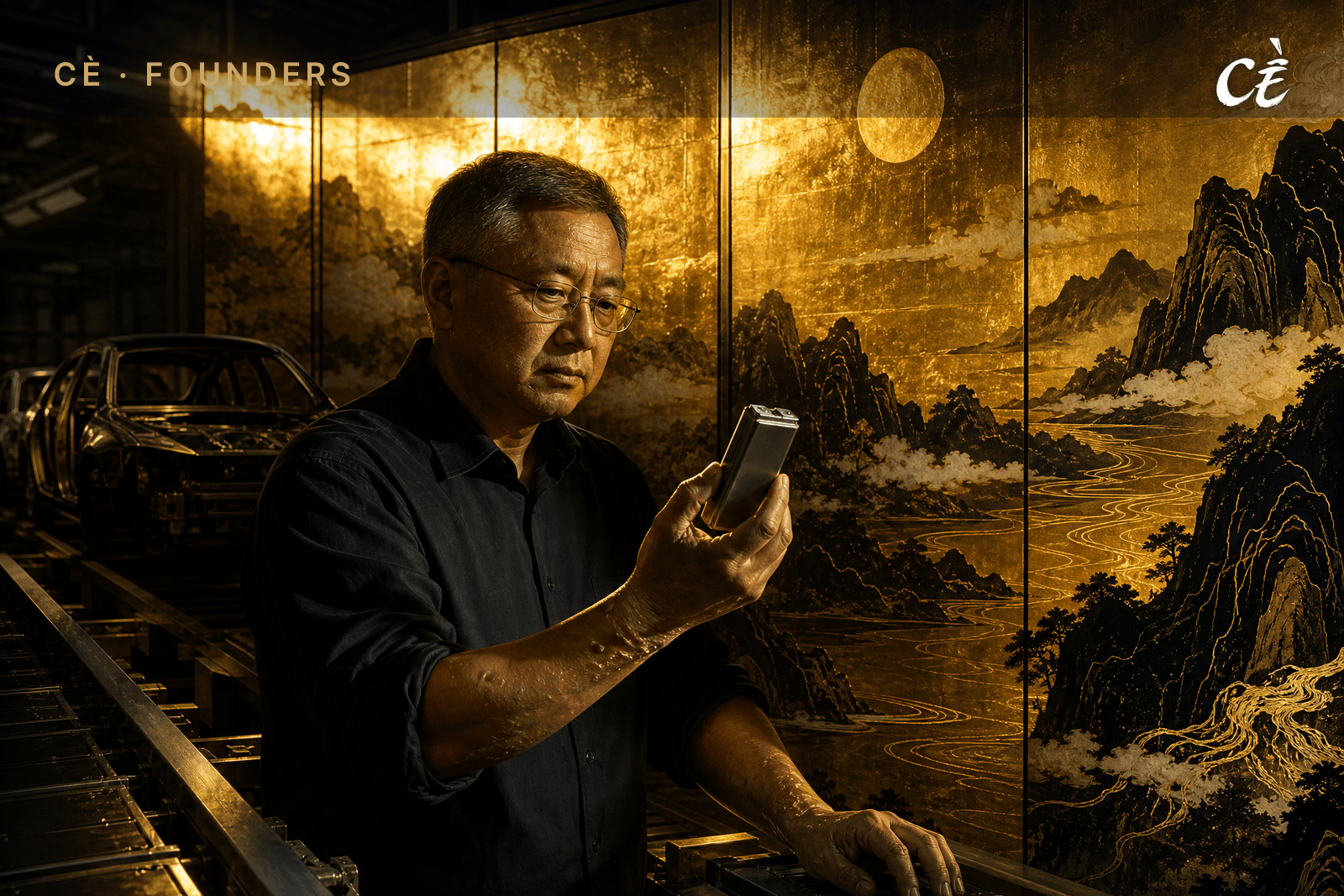
BYD’s profit fell 20.54 percent in the first half of 2026, and its chairman blamed the one habit the company was built around: making almost every part itself. On 29 September its board asks shareholders to approve a new financing arm nobody outside the company has been told the details of. The last time investors were asked to trust Wang Chuanfu on faith this size, they tried to dump the stock inside a week.
That was in January 2003.
Wang was thirty-seven, and BYD made nothing but rechargeable batteries. He spent the equivalent of US$34 million (HK$269 million) on a 77 percent stake in Xi’an Qinchuan Automobile, a failing state-owned carmaker in China’s interior, and told the market a battery company was now in cars.
Hong Kong did not wait to find out if he was right. BYD’s shares halved within days. Fund managers called Wang to say they were selling every share they held, and an analyst at Deutsche Securities wrote that the deal was overpriced, unrelated to BYD’s real business, and would tarnish the stock.
He told the doubters he intended to stay in cars, and specifically electric cars, for the rest of his working life.1
Twenty-three years later BYD still makes almost everything itself: the battery cells, the power electronics, the electric motors, even the chips that run the dashboard. When a global shortage of automotive chips stalled car plants everywhere in the early 2020s, BYD kept building, because it had never depended on anyone else’s chip in the first place.
This is the move. Bet on owning the layer everyone else outsources, and absorb the market’s verdict on the way in.
This is the move. Bet on owning the layer everyone else outsources, and absorb the market’s verdict on the way in.
The same habit is now the constraint. BYD’s second-generation Blade Battery, the company’s own lithium-iron-phosphate cell built to resist fire better than the industry standard, is still ramping capacity. The shortfall is what Wang pointed to when the company reported first-half revenue down 7.13 percent to roughly US$49 billion (CNY 344.82 billion) and net profit down 20.54 percent to about US$1.7 billion (CNY 12.33 billion).
The second quarter alone was stronger, net profit up 30 percent on the first. Gross margin, the slice of each sale left after the cost of building the car, hit 18.9 percent, the best reading in a year. The stock still fell 33 percent over the twelve months to June, and Wang spent that month in public asking shareholders for patience.
Outside China the strain does not show.
BYD’s plant in Rayong, Thailand, opened in July 2024 with room for 150,000 cars a year. It built its hundred-thousandth car on 23 September, four days before the vote.
A second plant in Subang, West Java, roughly US$1 billion and more than 18,000 jobs, starts production this quarter. A Malaysia assembly line and a smaller Cambodia plant round out a Southeast Asian footprint no other Chinese carmaker currently matches. Overseas sales overall rose 33.92 percent in the first half to about US$26 billion (CNY 181.27 billion), and BYD raised its 2026 international sales target to 1.5 million cars.
That is the shape of the vote on 29 September. Shareholders are asked to re-elect Wang alongside two new non-executive directors and three independent ones, and separately to approve a new asset pool, a financing structure backed by outside guarantees that lets a company raise money against one set of assets without loading the parent’s own balance sheet. BYD has not said which assets sit inside it.
Read against the numbers, the vote looks less like governance housekeeping and more like the next version of the 2003 bet. It would fund the overseas plants on their own books, answerable to their own lenders, insulated from a domestic margin squeeze that a battery line caused and a battery line will eventually fix.
The forecast: within twelve months BYD’s asset pool finances a named Southeast Asian expansion, most likely the Indonesia or Malaysia build-out, kept apart from the parent company’s China balance sheet. The load-bearing assumption is that the Blade Battery bottleneck is temporary and China margins recover before the new entity needs a second draw. If the bottleneck runs past mid-2027, or the asset pool turns out to fund something domestic instead, the call is wrong, and this column will say so.
He calls the shortfall temporary. The habit behind it has lasted twenty-three years.
He calls the shortfall temporary. The habit behind it has lasted twenty-three years.
Wang built a battery company that would rather lose half its market value in a week than buy a part from someone else. Twenty-three years later the habit is expensive again, in exactly the way that made him rich the first time.
Footnotes
-
Wang’s remarks around the Qinchuan deal are recorded in Chinese-language retrospectives of BYD’s founding; the account here follows the English-language version reproduced by CKGSB Knowledge. ↩