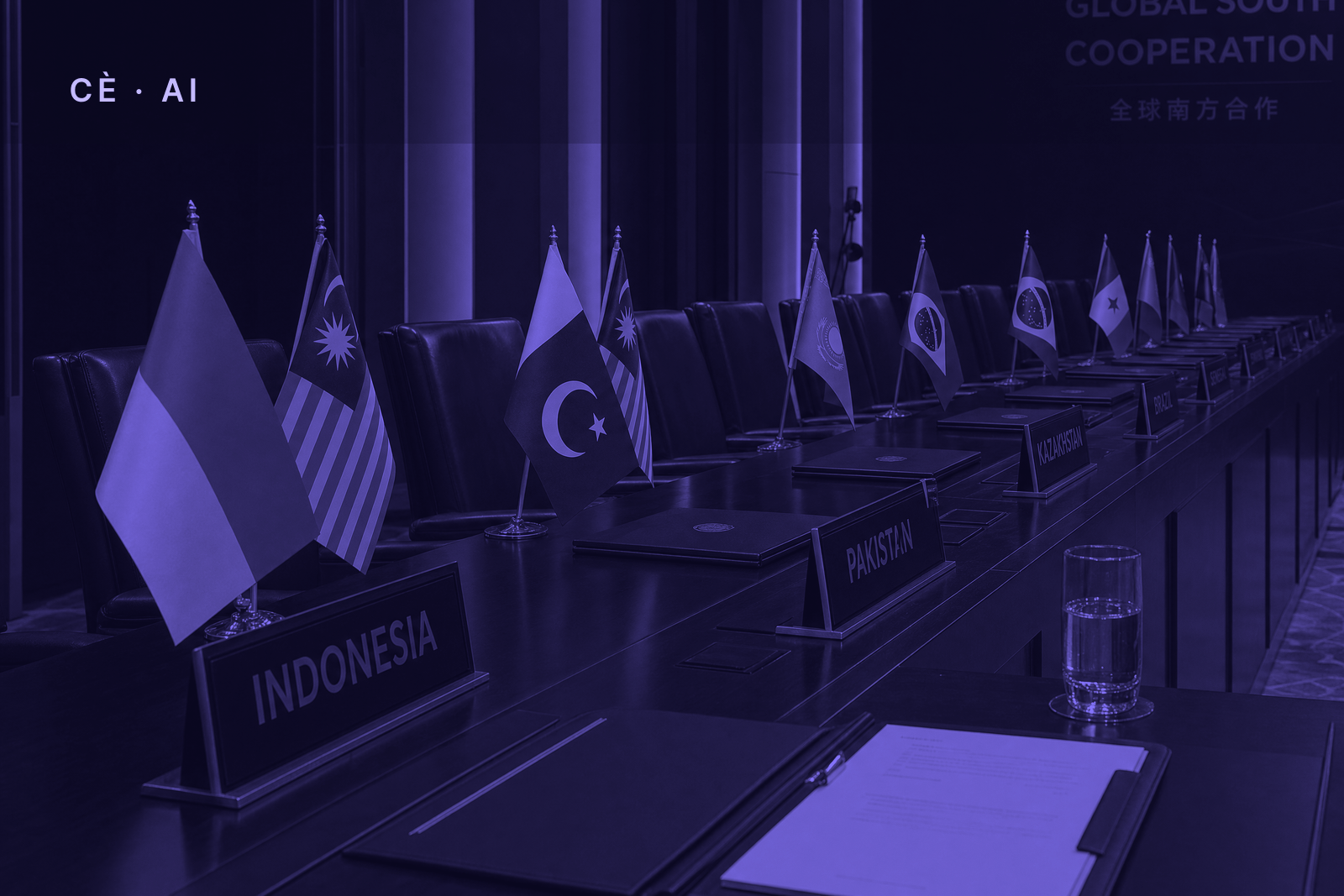
Twenty-nine governments put their names to a new international organisation in Shanghai this week, and the technology it was created to govern is made almost entirely by companies none of them own. On 16 July, a day before the World AI Conference opened its floor, the founding agreement of the World Artificial Intelligence Cooperation Organisation was signed. The next day Xi Jinping told the hall that AI development should be a “symphony of international cooperation” rather than a “solo performance” by any single country, called the new body “an important milestone in the history of AI development,” and pledged five thousand training places to the developing world. The membership leans hard toward the Global South: Indonesia, Malaysia, Brazil, South Africa, Senegal, Pakistan, Kazakhstan, Russia among them. The headquarters is Shanghai. The stated purpose is to write the rules.
The launch was covered as a governance bloc lining up against Washington, and it is that. The contest underneath is narrower and older. Standards-setting authority is not conferred by a ceremony; it accrues to whoever holds the thing the standard is written about. WAICO’s members can convene, declare, and vote. What they do not yet hold is the frontier, the compute and the leading models that the largest adopting markets actually run on. A body can govern a technology only to the degree its members supply or consume the version of it that matters. The distance between the signature and the substrate is the whole story.
This has happened before, in a different costume. In the spring of 1974 the same coalition, the Global South assembled at the UN General Assembly through the Group of 77 and the Non-Aligned Movement, adopted the Declaration on the Establishment of a New International Economic Order. It was sweeping: sovereign control over natural resources, fairer commodity prices, a rewritten trade and monetary system, technology transferred from the rich world to the poor. It carried on the numbers; the votes were there and the text was ringing. It produced almost no binding order. A declaration restructures nothing it does not also control, and the coalition did not control the capital, the technology, or the reserve currency the new order was meant to redistribute. Washington rejected it within weeks, the instruments were left non-binding, and the actual rules of the world economy kept being written where the capacity sat. WAICO is that Declaration carried into AI governance: a large Global-South majority moving to write the rules of a technology whose frontier it does not own.
A pledge is not a shell; a declaration is not a standard.
Xi is reaching for the governance card precisely because the other card is running against him. Washington’s chip-export controls are a wager that standards follow silicon, that whoever holds the compute frontier sets the terms everyone downstream must take. A convening body of the developing world is the counter-move on the one axis where China can still lead: legitimacy, headcount, and the procedural machinery of the UN system. It is a real move, and it inherits the 1974 weakness exactly. The members can pass a rule, and a rule is not a standard until the systems people actually build on are the ones the rule governs. A pledge is not a shell; a declaration is not a standard. The body announces governance. It does not conjure the frontier it would govern.
The small states in the room read the arithmetic more coldly than the ceremony suggested. Indonesia and Malaysia signed, and both are building data centres on whichever stack delivers the megawatts and the chips, hedging which silicon wins rather than swearing to one. Singapore, not a founding member, runs the purest version of the hedge: courting Nvidia’s frontier access and China’s cheaper volume compute at once, declining to let either bloc decide its adoption for it. For a small state, a standards body matters only when the standard is one its systems must obey to trade or to compute. WAICO does not yet hold that leverage, because the models its members run on are still, for now, made elsewhere.
So the forecast, datable and open to being wrong. By mid-July 2027, WAICO will not have produced a binding, widely adopted AI standard or governance rule that materially shapes how frontier AI is built. It will remain a declaratory and convening body, an assembler of communiqués and training pledges rather than a maker of rules the frontier obeys. The load-bearing assumption is explicit, and it is the hinge a grader should test: frontier AI capability, the models and the compute the largest adopting markets actually run on, stays concentrated outside WAICO’s membership through the window. If that assumption fails, the call fails with it. Should China’s domestic stack, Huawei’s Ascend accelerators and the Chinese frontier models, reach the Global South at genuine scale, and should WAICO become the channel through which that stack is adopted, then the body acquires real standard-setting teeth and this forecast breaks. That single development is what would convert the declaration into an order. Watch the adoption line, not the membership line. Confidence: likely.
Standards are downstream of the frontier, and the frontier is not signed into being.
The 1974 coalition was not wrong about the injustice it named. It was wrong about what a majority in a General Assembly could bind. Standards are downstream of the frontier, and the frontier is not signed into being.