Alibaba put Qwen3.8-Max into general release on 3 August, through Alibaba Cloud’s Model Studio and a new workplace agent platform called QwenWork. The weights follow during the week of 10 August, on Hugging Face and ModelScope.
Two point four trillion parameters, roughly 95 billion of them active on any given token, a context window of one million, and API pricing at US$2 per million tokens in and US$6 out. Alibaba kept several flagship releases proprietary earlier this year, and this one it has promised to hand over.
A dated promise is a promise, and Alibaba has not published the licence.1
Assume it lands. A model at the frontier of what anyone has built becomes a file that a mid-sized logistics firm in Surabaya can pull down and run on rented GPUs.
The scarce input in an AI project stops being intelligence.
Singapore’s Economic Development Board, with McKinsey and Tech in Asia, surveyed more than 300 companies running AI across Singapore, Malaysia, Indonesia, the Philippines, Thailand and Vietnam. Nine in ten said they stood ready to experiment with agentic AI. They are putting 11 to 40 percent of technology budgets into it, and few report any movement in bottom-line performance.
That gap was never a capability gap.
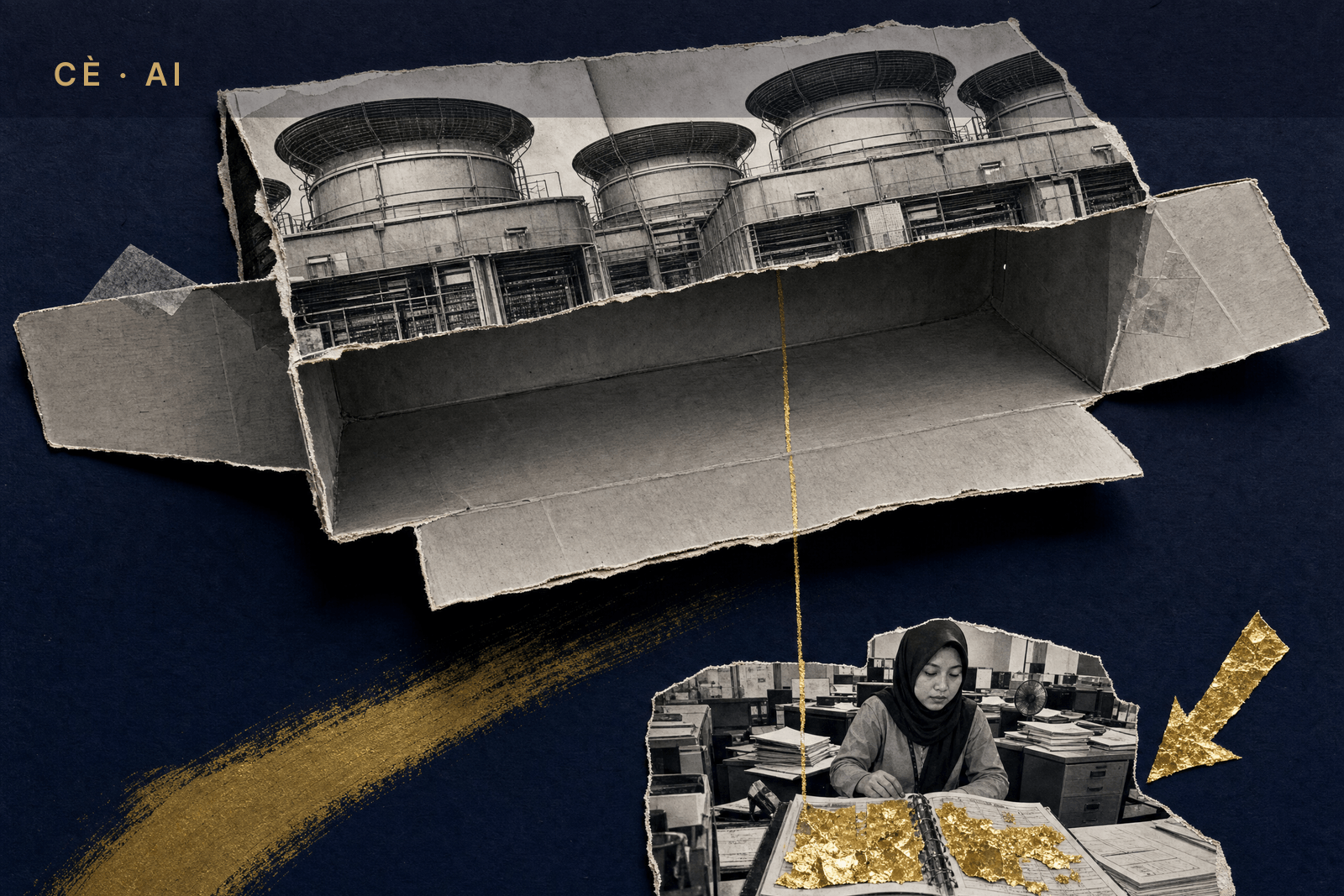
What a Qwen download cannot touch is the operator’s own record. Nine years of transaction history, the supplier list carrying the terms paid rather than the terms quoted, the reason the Tuesday container clears late. The warehouse manager has never written that last one down.
A frontier model with none of that is an intern with a large vocabulary.
A frontier model with none of that is an intern with a large vocabulary.
The benchmark tables argue the same point from the other side. Qwen3.8-Max ranks fifth among text models on Arena and second on the vision board, and on Terminal-Bench 2.1 it scores 86.6 against GPT-5.6 Sol at 88.8, ahead of Claude Opus 4.8 and Claude Fable 5 at 84.6.
Near-parity at the top, across three labs on two continents, is what a commodity looks like early.
Near-parity at the top, across three labs on two continents, is what a commodity looks like early.
The businesses that should read that table twice are the ones whose whole pitch is a wrapper. QwenWork went into public beta the same week, aimed at Tencent’s WorkBuddy, Moonshot’s Kimi Work, Claude Cowork and ChatGPT Work.
The counter is real, and it is about where the data goes. Alibaba Cloud opened a two-data-centre region in Johor in June, its fifth Malaysian facility and the largest footprint it holds in Southeast Asia, and its general manager confirmed that Singapore customers would run on it.
Proximity settles latency. Jurisdiction, lock-in, and which government can ask what of whom stay open.
So the opening move is narrow. Draft, translate and summarise in-house, where a leak costs embarrassment rather than a contract, and keep customer records and supplier terms off the API until the weights run on infrastructure the company controls. Read the LICENSE file on the day it appears, because Qwen 3.5 and 3.6 shipped Apache 2.0 and precedent is a pattern rather than a commitment.
By the end of next week the most capable model Alibaba has built may cost a download. The nine years of delivery notes in the Surabaya back office stay where they are, and no repository holds a copy.
Footnotes
-
Eight days between the announcement and the promised drop, which is long enough for a licence to acquire a clause. ↩