
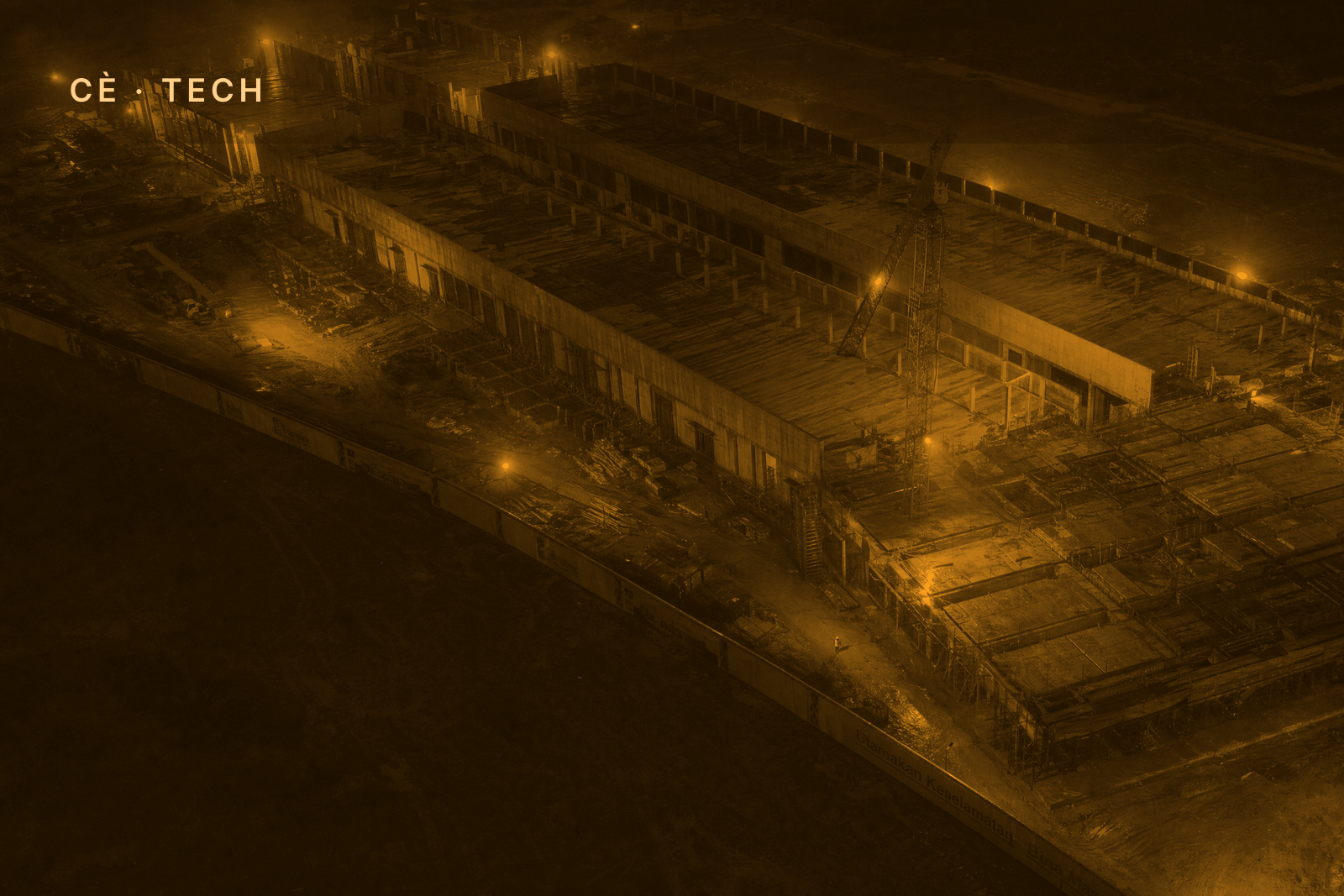
In Johor the concrete keeps pouring. In the first week of July, across the strait in Singapore and up the peninsula in Kuala Lumpur, the people who kept TikTok governable were walked to the lift. Singapore lost trust-and-safety staff for the second July running; a ByteDance quality-assurance specialist in Kuala Lumpur described being escorted out of the office; more than 450 technology roles went at the TikTok Shop and Tokopedia unit in Jakarta; Dublin shed about 300.1 The same fortnight, ByteDance’s regional build-out did not pause.
Call it the capex substitution. A platform is converting the part of its cost base that is human, variable and in-region into the part that is capital, fixed and automated, and Southeast Asia is where both halves of the trade land at once.
Read the cost stack. Moderation and commerce operations are labour: they scale with users, they sit as opex on the quarterly line, and until now they scaled inside the region because content is local and the languages are local. Servers and models are capital: you pour the concrete once, and the marginal cost of screening the next video trends toward the price of electricity. AI is the machine that moves work from the first column to the second. TikTok has already told Brussels how far along the shift is, automating roughly 94 percent of violating-content enforcement in the EU in the second half of 2025, backed by 91 staff and 3,583 contracted moderators against 112 million removals. The Southeast Asian version of that ratio is being written now.
This is why the region gets the servers and loses the payroll. ByteDance has earmarked about US$2.4 billion for data centres and an AI hub in Malaysia, anchoring the first Bridge campus at Sedenak in Johor, and TikTok has committed US$8.8 billion to data centres in Thailand over five years. Those are enormous assets that employ almost no one: a hyperscale hall runs on dozens of technicians, not the hundreds of moderators it displaces. The capex stays in the region because power, land and data-residency rules keep it here; the opex leaves because a model in the same building can do the reading.
Southeast Asia is being handed the electricity bill and the buildings, and asked to call it investment.
Southeast Asia is being handed the electricity bill and the buildings, and asked to call it investment. There is a second reading, and it is where the useful part sits. The people cut this month built the escalation trees, the policy taxonomies and the quality rubrics that let a platform stay legible while it grew to a billion users. Process is the thing a model still cannot originate, only run once someone has designed it.
For an operator who builds systems rather than buys headcount, that is a hiring signal with a date on it. The best trust-and-safety and operations people in the region are on the market this July, carrying exactly the institutional knowledge that ByteDance decided to expense. An operator in Jakarta or Singapore who hires one of them is buying a decade of hard-won process for the price of a severance cheque someone else already wrote.
The capex stays in the region because power, land and data-residency rules keep it here; the opex leaves because a model in the same building can do the reading.
The concrete in Johor will cure either way. The people who taught the machine what to look for are the ones now free to teach it somewhere else.
Footnotes
-
TikTok’s line is that none of this is a layoff. Its Indonesia executive director called the Tokopedia cuts “workforce restructuring and internal mobility,” and the company says it is hiring for more than 100 roles in the country. The 450 who left may parse the distinction differently. ↩