
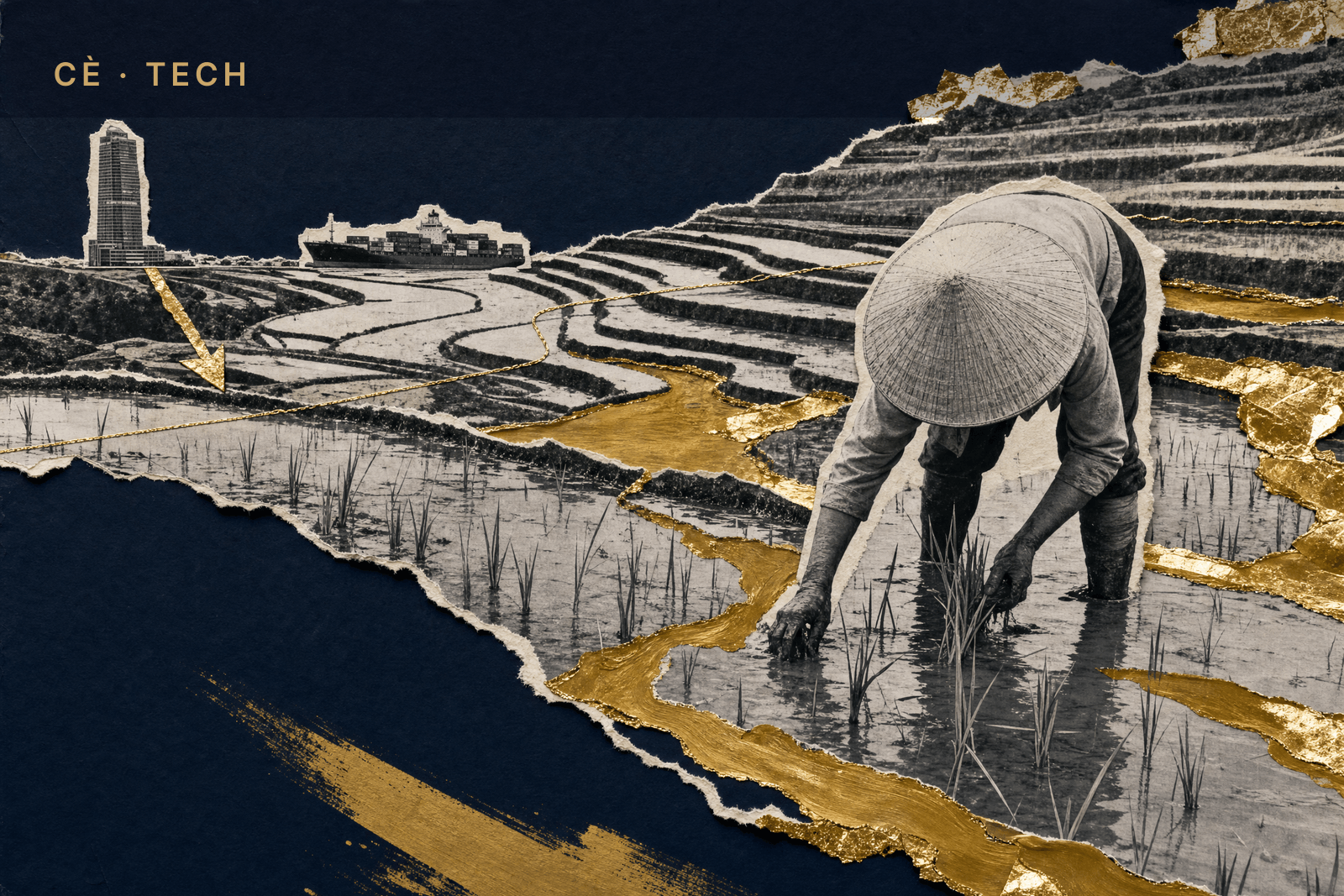
BNP Paribas Asset Management, the Rockefeller Foundation, Temasek and Breakthrough Energy Ventures signed onto the same term sheet last week. What they were buying was rice. On 16 July, Singapore-based Rize closed a US$31 million Series B: US$20 million of equity led by BNP Paribas Asset Management Alts, and US$11 million of debt from UOB, BIDV and Temasek Foundation.1 The money goes into flooded fields in Vietnam and Indonesia.
Read past the rice and the signal is simple. This much institutional money is now flowing toward a thin software layer bolted onto dirt, water and methane, the least glamorous supply chain in the region. A durable edge in AI shows up here, on top of a physical business nobody with a pitch deck wants to run, more reliably than it shows up in the next chat assistant.
Rize launched in late 2022 and has since reached about 17,000 smallholder farmers across more than 50,000 hectares in Vietnam and Indonesia, shipping 1,500 tonnes of low-emission rice to Europe, Canada, Australia and Singapore. The Series B takes total funding to US$47 million. It pays for three things: export expansion, carbon programmes, and AI tools for the farmers and field teams who work the paddies. The artificial intelligence is the last item on the list, and it sits on top of the first two.
The physical work is the barrier to entry. Rize’s core method, alternating wetting and drying, drains and re-floods the paddy in cycles instead of holding it under water for the whole season. Done right it cuts methane by roughly half and water use by up to 30 percent, and lifts farmer income by around 30 percent without dropping yield. None of that is a model output. The software’s job is narrower and more valuable: verify the cycles, schedule the drain-downs, and turn the avoided methane into carbon revenue a European buyer will actually pay for. That is a ten-percent tightening of a real process, and it compounds every season.
The durable edge is the mud the software sits on, and no one holding a pitch deck wants to stand in it.
The durable edge is the mud the software sits on, and no one holding a pitch deck wants to stand in it. Agri margins are thin and the operations are brutal, which is exactly the condition that leaves the room empty. A chatbot can be cloned in a weekend by anyone with an API key. A network of 17,000 farmers running verified wetting-and-drying cycles, with the trading relationships and the carbon paperwork that make the tonnes saleable in Europe, takes years of standing in water to build.
The lesson for a founder in Ho Chi Minh City or Jakarta is about the structure, not the crop. The same shape is available in any boring supply chain they already know cold: cold-chain logistics, palm-oil traceability, cement, aquaculture, spare-parts distribution. The winner is whoever takes the physical business with the brutal operations and the thin margins and adds the software layer that makes it a few points tighter. The thin margins are the reason the room is empty, and the empty room is the whole opportunity.
The artificial intelligence is the last item on the list, and it sits on top of the first two.
So four institutions with nothing to prove put their names next to a debt tranche secured against Vietnamese rice. The US$11 million of debt is the tell. Banks lend against shipped tonnes and physical receivables, not against a demo. The paddies were there the whole time. The capital only just walked into the field.
Footnotes
-
Temasek appears twice on the page, once in the equity and again, as Temasek Foundation, in the debt tranche. Read it as conviction, or as a quiet hedge against its own conviction. ↩