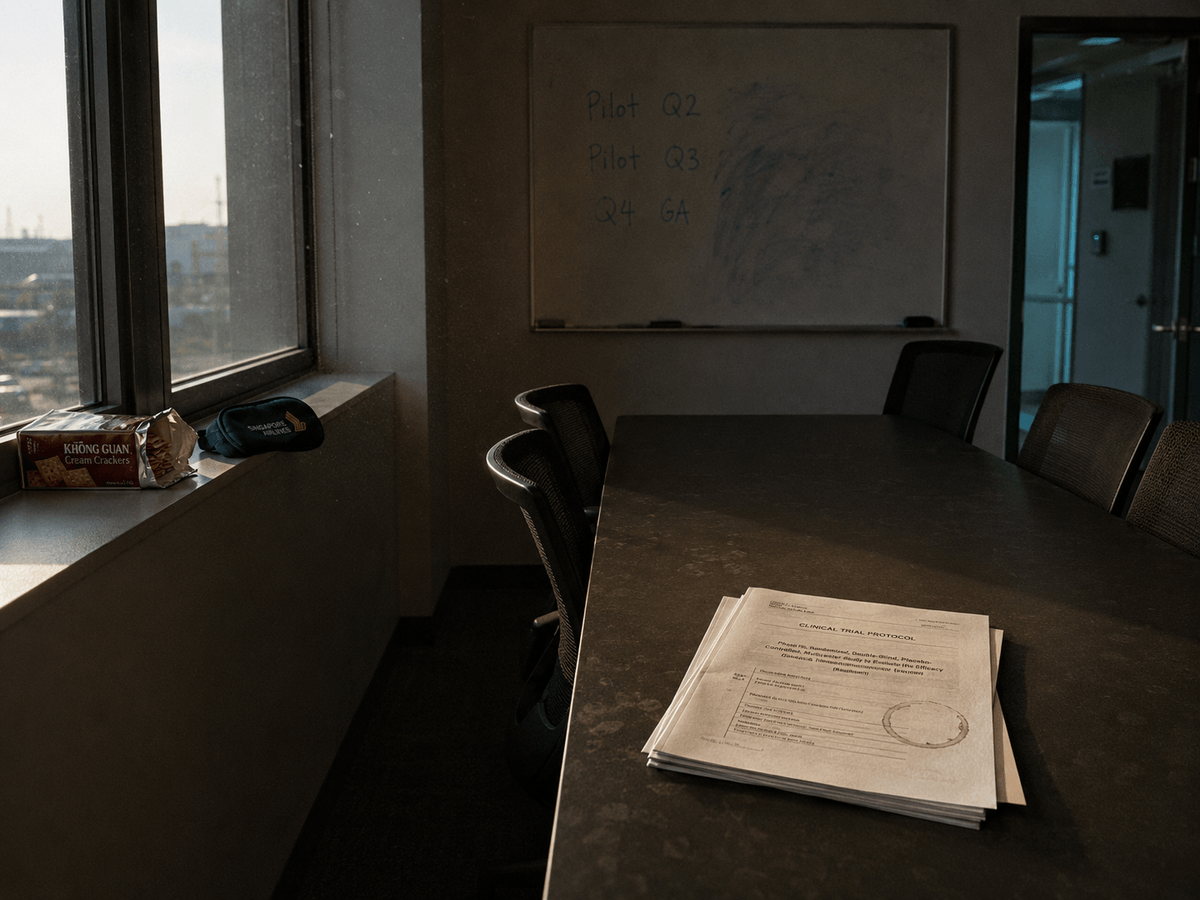
Novo Nordisk and OpenAI announced on April 14 that the world’s most valuable pharma will run its drug discovery, clinical trials, manufacturing, supply chain, and corporate functions through OpenAI’s models, with full integration by the end of 2026. Pilots are already running across R&D, manufacturing, and commercial operations. Bloomberg framed the deal around the obesity-drug race against Eli Lilly. The framing is too narrow.
The discovery story is the press release. It is also the part of the announcement that overlaps least with what cè readers in Singapore should be tracking. AI drug discovery is now common: Insilico Medicine’s ISM018_055 became the first fully AI-generated drug to enter Phase II trials, the company IPO’d in Hong Kong in late 2025 raising close to US$300 million, and WuXi AppTec is testing AI-generated compounds for Insilico under a strategic partnership. The pharma industry has decided molecules can come out of models. That is settled.
The thing Novo Nordisk just did that no top-three pharma has done before is hand OpenAI everything else: the manufacturing schedule, the supply chain, the commercial operation, the corporate functions. Drug discovery is the showroom. The end-to-end deployment by year-end sits with everyone Novo touches.
Novo Nordisk’s regional headquarters for Asia-Pacific operates from 152 Beach Road, ten floors above the Gateway East lobby. The branch handles wholesale of medicinal and pharmaceutical products across the region. Manufacturing in Singapore’s biotech cluster belongs to Pfizer, GSK, Novartis, Sanofi, Merck, Lonza; Novo’s Singapore footprint is the commercial layer. The commercial layer is the part of the deal that goes through OpenAI by the end of this year.
For the contract research organisations and specialist suppliers in Tuas Biomedical Park and Biopolis, Novo’s Singapore office will start pulling more analysis through GPT models. That is the easy read. The harder one is what their own clients expect once the parent goes AI-native. Thirty-five percent of CROs globally had integrated AI into trial operations by mid-2025. The CROs that had not were already on the slow track. With Novo’s announcement, the slow track gets shorter.
The other end of the cluster is moving too. Baidu’s PaddleHelix has been running drug-discovery models on the search company’s compute for years; Tencent and Hillhouse anchor the Chinese AI-biotech investor base; Insilico’s Hang Seng listing gave the sector a public reference price. The Western pharma giant just publicly committed to a single-vendor AI deployment on a calendar deadline. The Chinese AI-pharma stack has been operational for longer, on a different vendor mix, with state capital underwriting much of it.
When the foreign pharma in your tower runs every supplier interaction through agents on a 24-hour clock, the Singapore CRO that responds in 72 hours loses the renewal.
Singapore’s biotech cluster sits in the middle. The cluster’s pitch has been physical and regulatory: the labs, the talent visa, the IP regime, the IRAS rulings. Those are still real. The cluster’s competitive weakness is operating cadence. When the foreign pharma in your tower runs every supplier interaction through agents on a 24-hour clock, the Singapore CRO that responds in 72 hours loses the renewal.
The forward read is whether EDB, A*STAR, and the Tuas tenants treat the Novo announcement as a Denmark story or as a Singapore deadline.[^1]
The Chinese AI-pharma stack has been operational for longer, on a different vendor mix, with state capital underwriting much of it.
[^1]: One detail the press release did not surface: OpenAI will, per the announcement, “support Novo Nordisk in building AI fluency across the company’s global organization.” In a vendor-pharma deal of this size, fluency-building usually means seconded staff. The Singapore office gets some.