
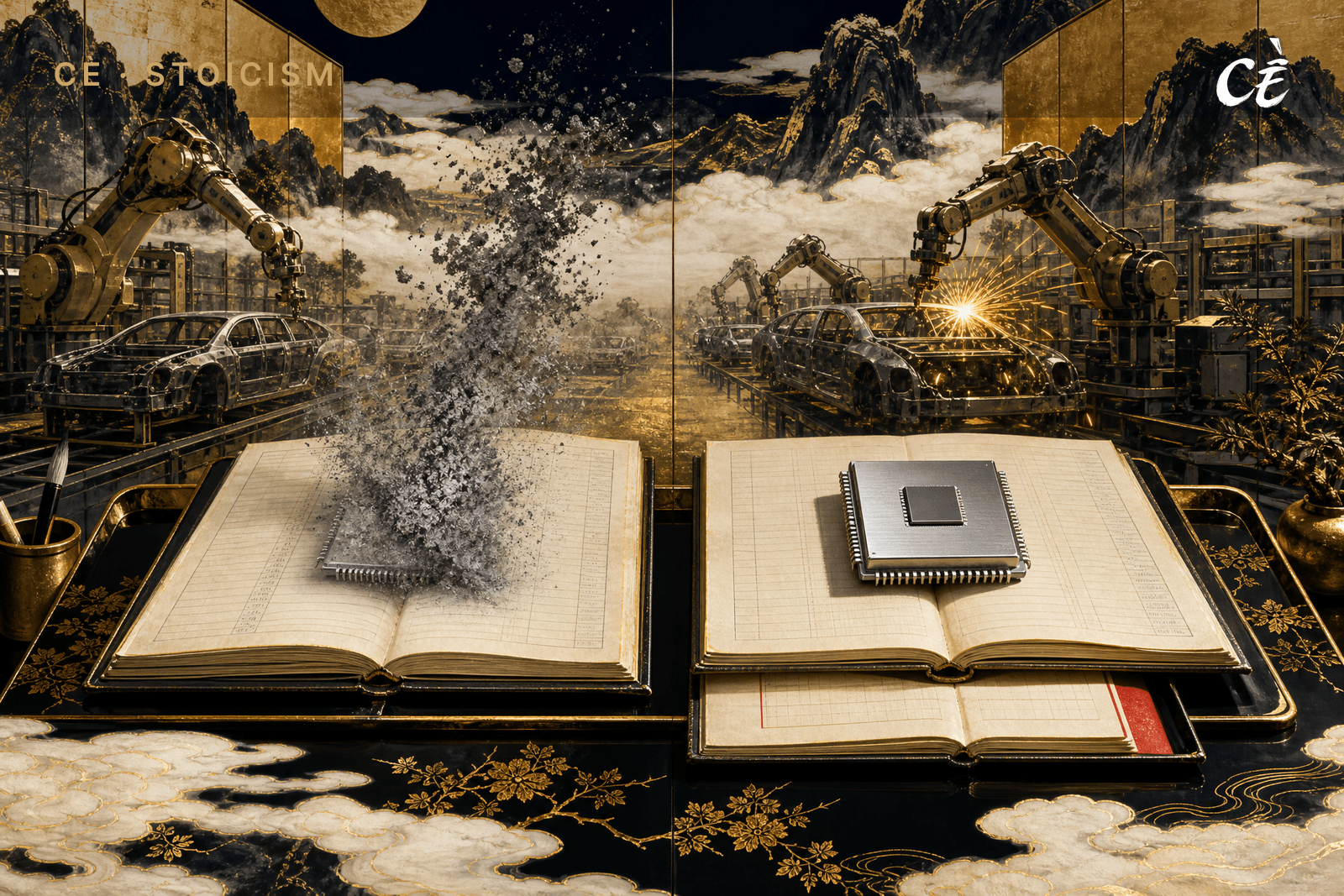
A single automotive chip, smaller than a fingernail, cost Honda close to a billion dollars this winter. China blocked shipments of it from Nexperia, the chip’s maker, after a European government seized the company in a dispute over who actually controlled it. If your business runs through one supplier, one bank, or one licence, the same block is already waiting somewhere ahead of you.
In the year 64, the Roman philosopher Seneca wrote to his friend Lucilius about a city that vanished in one night. Lugdunum, a prosperous river colony on the site of modern Lyon, burned to nothing between one evening and the next dawn. Seneca had never once worried about Lugdunum by name.
He had simply stopped assuming any single fortune was safe from a single bad night.
He had simply stopped assuming any single fortune was safe from a single bad night.
He told Lucilius that a wise mind walks forward to meet trouble before it arrives, asking not what usually happens but what can happen. The Stoics called the habit premeditatio malorum, the discipline of rehearsing the worst in plain detail before it shows up at your door. Rehearse it well, Seneca argued, and disaster loses most of the power it has, which was always the power to surprise you.
Nexperia’s customers got almost no rehearsal at all.
On 30 September 2025, the Dutch government invoked a Cold War-era law it had never used before to take control of Nexperia, a chipmaker owned by China’s Wingtech, over fears its technology could pass out of Dutch reach. China’s commerce ministry answered four days later, banning Nexperia’s Chinese unit from shipping the finished chips it packages there, the same small parts wired into nearly every modern car.
Within three weeks, Bosch and its suppliers Aumovio, ZF and Hella were days from stopping their own assembly lines. Honda told investors the shortage would cost it about 110,000 cars, roughly US$969 million (¥150 billion).
Two of Nexperia’s other customers paid nothing at all.
Two of Nexperia’s other customers paid nothing at all.
Melecs, an Austrian parts maker, and Jabil, the contract manufacturer whose factories run from Penang to Guadalajara, kept buying from Nexperia’s Chinese entities directly and settled the invoices in yuan instead of dollars or euros. Nothing about that route was improvised in October. It existed already, quietly, because someone at each company had once asked what happens if the usual way stops working, and built a second way while it cost nothing to build.
Nobody could have named Nexperia back in August 2025, the way nobody in Lugdunum could have named the spark that started their fire. Seneca’s rehearsal never asked for that kind of precision.
It asked only for a second door before the first one shut.
Name the one supplier, one bank, or one licence your business could not survive losing, and open some second route to it this week, small as it can be, while nothing is forcing you to.
Nexperia learned its own lesson the expensive way. By February 2026 it had committed more than US$300 million to a new factory in Malaysia, moving roughly 90 percent of its production out of China, so that the next government to seize a factory somewhere cannot freeze the whole supply again.1
Lugdunum’s citizens rebuilt on the same riverbank, having learned, too late, exactly what Seneca had already written down for them.
Nothing ought to be unexpected by us.
Footnotes
-
Nexperia was still moving nine-tenths of its production out of China as late as February 2026, four months after Beijing eased the export ban, which says something about how long a single squeezed chokepoint keeps squeezing even after the politics move on. ↩