
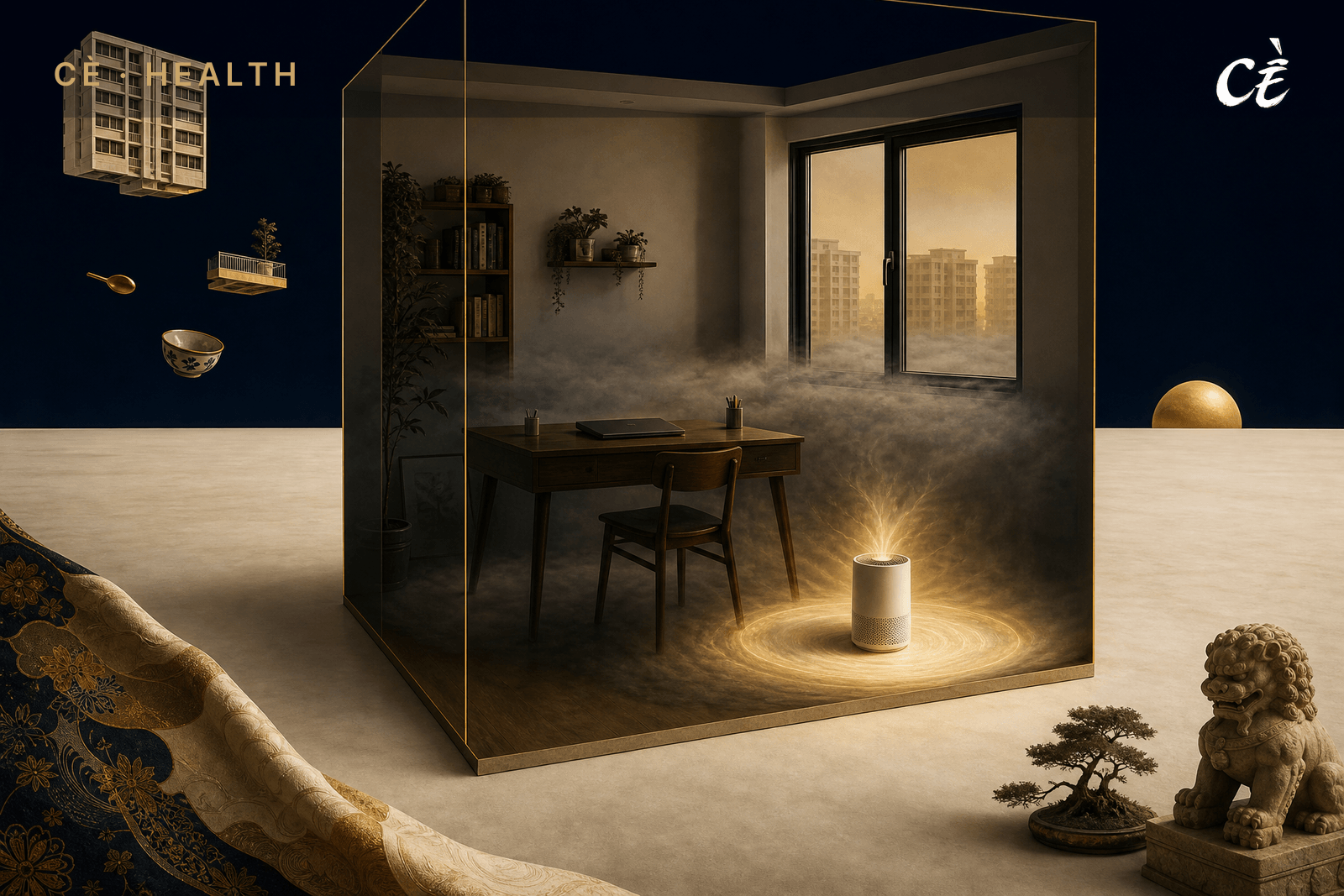
At noon on 4 September, central Singapore’s 24-hour PSI read 105.
The west read 89, the south 75, and the schools stayed open. It was the first time haze had pushed any part of the island into the unhealthy band since 2023, and the smoke came from fires in southern and central Sumatra and Kalimantan.
For a desk worker, the official advice changed almost nothing. NEA asks healthy adults at PSI 101 to 200 to cut long, hard outdoor exertion, and the Ministry of Health says an N95 is generally not needed for a commute. So you shut the window, turn the air-con down a degree, and keep working.
That is where the data gets uncomfortable.
Between 2018 and 2020, researchers led by Jose Guillermo Cedeño Laurent tracked 302 office workers in 42 buildings across six countries, Thailand among them, and tested them at their desks. For every 8.8 µg/m³ rise in indoor PM2.5, response times slowed 0.82 percent and correct answers per minute fell 0.7 percent. Above 12 µg/m³, the link held on four of five tests.
On 4 September, central Singapore’s outdoor PM2.5 read 64 µg/m³ at 8am.
A slower answer on a screen test sounds small, so look at a payroll. Tom Chang, Joshua Graff Zivin, Tal Gross and Matthew Neidell matched the daily output of 5,000 call-centre workers in Shanghai and Nantong to the local pollution index. Each 10-point rise cut calls handled by 0.35 percent, and the loss came from longer breaks while call length held steady.
The staff working from home lost output the same way.
NEA’s own haze guidance explains why. Closing doors and windows reduces the rate particles come in, and a sealed, occupied room builds heat and carbon dioxide, which in the Cedeño Laurent data slowed thinking more than the particles did.1
The filter does the work the window cannot.
In a 2014 double-blind trial in Shanghai, 35 students lived with a real or a sham air purifier for 48 hours. The real one cut dormitory PM2.5 57 percent, from 96.2 to 41.3 µg/m³, within hours, and systolic blood pressure fell 2.7 percent. The particle count is randomised-trial evidence; the blood pressure is a 35-person read.
The sizing is arithmetic, and NEA publishes it. A purifier with a HEPA filter should carry a smoke CADR, in cubic feet per minute, of at least three times the room’s volume in cubic metres.
A unit rated below that number is cleaning a smaller room than the one you are sitting in.
A 12 m² home office with a 3 m ceiling holds 36 m³, so it needs a smoke CADR of 108 or more. NEA’s worked example, a 40 m² room, needs 360. A unit rated below that number is cleaning a smaller room than the one you are sitting in.
The protocol costs you two readings a day. NEA points you to the 1-hour PM2.5 for what you do in the next hour, and the 24-hour PSI forecast the evening before for tomorrow’s plan: the day the door stays shut, the purifier runs on high, and the window opens again once the number drops.
ASEAN’s weather centre raised its southern haze alert to Level 3 on 26 August, and the 8 September forecast still ran from moderate to low unhealthy.
The number on the back of the purifier decides how much of it reaches your desk.
The noon reading will come back. The number on the back of the purifier decides how much of it reaches your desk.
Footnotes
-
NEA is careful on the other side too: its guidance notes there is little robust data on the longer-term effects of short-term haze exposure of the kind Singapore sees, because most studies measure years of polluted air, not weeks. ↩