
Thirty-six healthy adults. Ten weeks. Two arms, randomised: one built on fermented food, one built on fibre.
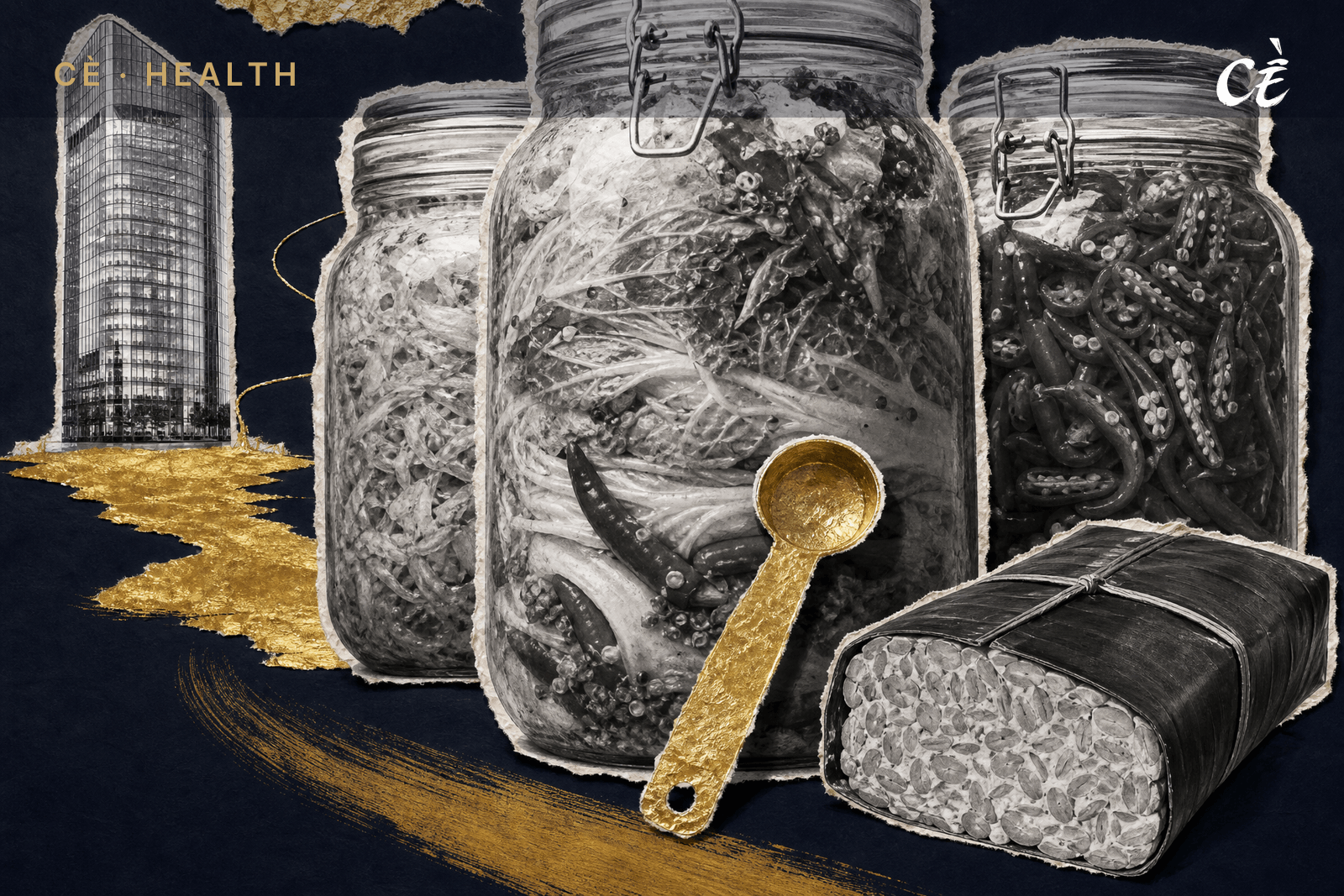
The fermented arm ate yoghurt, kefir, fermented cottage cheese, kimchi, brined vegetables and kombucha. Microbial diversity rose, and it rose further at larger servings. Nineteen inflammatory proteins fell, interleukin 6 among them.
The fibre arm ate legumes, seeds, wholegrains, nuts, vegetables and fruit. Microbiome diversity held flat.
Not one of the 19 moved in the fibre arm.
Not one of the 19 moved in the fibre arm.
That result, published in Cell in July 2021 by Hannah Wastyk and Gabriela Fragiadakis with Justin Sonnenburg, Erica Sonnenburg and Christopher Gardner at Stanford, is still the cleanest randomised read anyone has on moving a human immune panel with food.
Annual cost of the intervention: groceries.
Now the capital. Longevity biotech raised about US$2.18 billion across 16 disclosed rounds between August 2024 and July 2026. Retro Biosciences took US$1 billion of it in a single Series A in January 2025, 45.9 percent of everything disclosed in the period, and epigenetic reprogramming as a category absorbed US$706 million across five deals.
NewLimit raised the largest of those rounds, US$435 million in June 2026, as clinical trial financing. The trials are what the money is for.
The evidence grade matters here more than the effect size. The Stanford result is a 36-person, 10-week randomised trial on surrogate markers, which puts it at Level 2 and says nothing about how long anybody lives.
What it does say is that the panel moved, which is more than most of what you are being sold has shown.
And the association data underneath it is messier than the headlines. A Nature Aging cohort in 2023 found centenarians carrying youth-associated signatures in the gut. A Hainan longevity group of 25, 12 of them past 100, ran the other way: butyrate producers such as Faecalibacterium prausnitzii were depleted, while Escherichia coli and Desulfovibrio piger were enriched.
Two longevity populations, two opposite microbial profiles. Anyone selling you a single target organism is ahead of the data.
The regional detail is the one worth sitting with. Singapore’s National Nutrition Survey 2022 found that wholegrains make up 4 percent of staples consumed, down from 5 percent in 2019, while daily sodium reached 3,620mg against a recommended ceiling under 2,000mg.
The fermented half of that plate, the belacan, the tempeh, the tapai, the pickled greens, was default household food across this region two generations ago. It left the table on the way to convenience, and it is now being sold back at clinic prices.
What the trial actually supports is narrow, and the narrowness is the point: ten weeks of fermented food produced a dose response, with the larger servings carrying the larger effect. That is a shopping list and a fridge shelf, and it is the only intervention in this field priced where a whole population can reach it.
What it does not support is a supplement stack, a stool test, or a transplant. Faecal microbiota transplantation outside a clinical setting remains Level 3 territory with real harm on the record.
The protocol that produced the cleanest immune result of the decade was a shopping list.
The protocol that produced the cleanest immune result of the decade was a shopping list.
The next readout to watch is the first reprogramming programme to reach human dosing, because that is when the US$706 million stops being a bet on mechanism and starts being data. Until it lands, the honest ranking has not changed: the cheapest intervention has the best evidence, and the most expensive one has the best story.