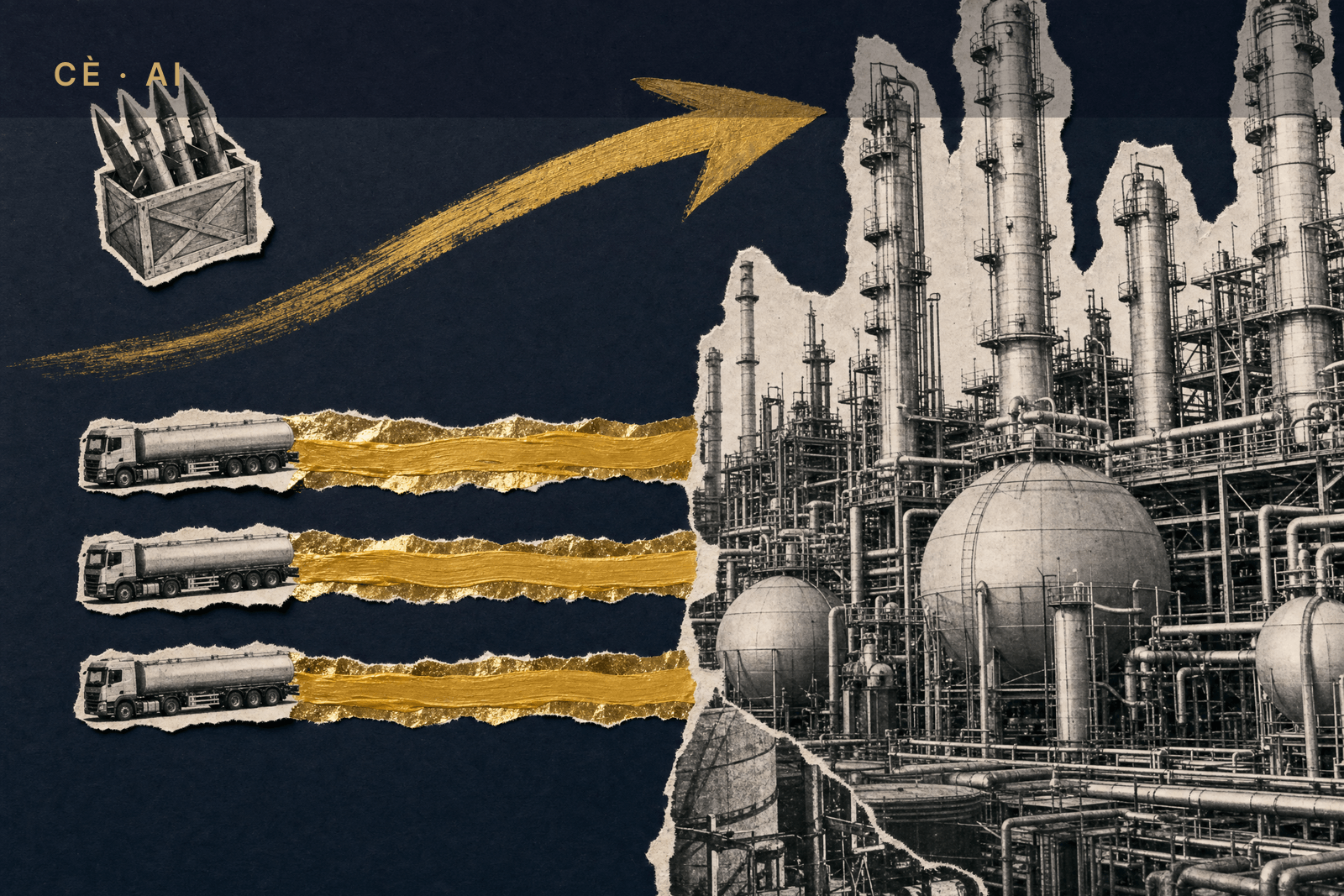
Iran sold more than eighty percent of its shipped oil last year to a single customer. That customer has now said in public that it will not arm it.
On 25 July, with American strikes running into a second week, Trump wrote that Xi Jinping had told him in Beijing that China would not, under any circumstances, give or sell weapons to the Islamic Republic, and that the undertaking covered Chinese companies. He said Putin had told him the same thing. He added that doing otherwise would be very bad for them.
The pledge is the headline. Why it was cheap to give is the subject.
Tehran’s whole position rests on an assumption about dependence: that a patron taking four-fifths of its exports, through a strait the United States has blockaded since four in the afternoon on 14 July, cannot afford to watch the supplier go under. It is the oldest wager a resource exporter makes, and it already has a name and a result.
In 1858 James Henry Hammond told the United States Senate that cotton was king. Three years later the Confederacy staked a war on the sentence, holding cotton back from Liverpool on the theory that a Britain with a quarter of its population living off textiles would break the Union blockade to get the crop moving again.
Britain declined.
By the spring of 1861 European warehouses were sitting on a surplus from the previous harvest, which bought Lancashire a year of not needing to decide anything. Britain then raised Indian cotton output by roughly seventy percent and stood up Egyptian and Brazilian supply behind it, Brazil going from twelve thousand tonnes to sixty thousand across the decade. Mason and Slidell sailed in November 1861 to collect the recognition the theory had promised, and collected nothing.
The cotton was real. The dependence was real. The substitutes arrived faster than the leverage could be spent, and Britain never recognised the Confederacy.
The deep variable is substitutability, read from the patron’s side rather than the client’s, and in this case the client publishes the number on its own invoice.
A standing discount of that size is the price a seller pays for having fewer buyers than the buyer has sellers.
Iranian crude clears into China at discounts that routinely run past ten dollars a barrel under Brent. A standing discount of that size is the price a seller pays for having fewer buyers than the buyer has sellers. Shandong’s independent refiners take it because it is the cheapest reliable feedstock available to them, which is a different proposition from taking it because nothing else exists.
The rest of the arithmetic sits in the same column. Sanctioned crude from Iran, Russia and Venezuela together made up as much as forty percent of Chinese imports by 2025, a sentence that contains its own substitutes.
Then there is the water. Every Iranian barrel bound for Shandong crosses the strait Washington is currently throttling, which makes the Chinese interest in this war the passage staying open rather than the client staying armed. Shipping weapons to the party being struck is the most direct available method of keeping the strait shut, and the second-order cost of that lands on Chinese refining margins rather than on anyone in Tehran.
So Beijing’s abstention costs it nothing it wanted.
What Beijing will spend, it has already shown it will spend. On 3 May the Ministry of Commerce issued a prohibition order blocking American sanctions against five refineries, Hengli Petrochemical and Shandong Jincheng among them, which protects the barrels and commits nothing to the regime selling them.
That is the shape of the support. Cover for the trade, and nothing for the state.
Russia’s identical pledge runs on a ledger of its own. Moscow competes with Tehran for the same discount-hungry buyers in Shandong, so an Iranian export machine under American pressure widens the Russian share of exactly the barrels Russia is trying to move. A patron with that incentive structure does not need to be threatened into abstaining.
For Southeast Asia the transferable lesson is narrower than the war. A great power’s public undertaking is worth what its alternatives are worth, and the alternatives are usually priced somewhere in the open market if anyone bothers to look.
Singapore’s own doctrine, stockpile against the lane closing and diversify until no single supplier’s leverage bites, is the same calculation run from the weak side. Arrange never to be the seller offering ten dollars off.
The forecast, then. Through 27 July 2027, China will not make a publicly confirmed transfer of major offensive weapons to Iran, meaning combat aircraft, ballistic missiles, or advanced air-defence systems; Chinese support stays inside the pattern already established, buying the oil and shielding the buyers. Likely rather than conviction, because the assumption underneath it is doing real work.
That assumption is the substitutes. The call holds only while Beijing keeps credible non-Iranian sources of discounted crude, and one of them is already thinning: Venezuelan flows ran around 389,000 barrels a day in 2025 and are projected to fall by as much as seventy-four percent this year.
Squeeze the Russian channel as well and Iranian supply stops being the cheapest option and starts being a necessary one, at which point the dependence Tehran has been asserting becomes true and the abstention gets expensive.
Watch the discount, not the communiqué. It has been the tell since Liverpool.
Watch the discount, not the communiqué. It has been the tell since Liverpool.