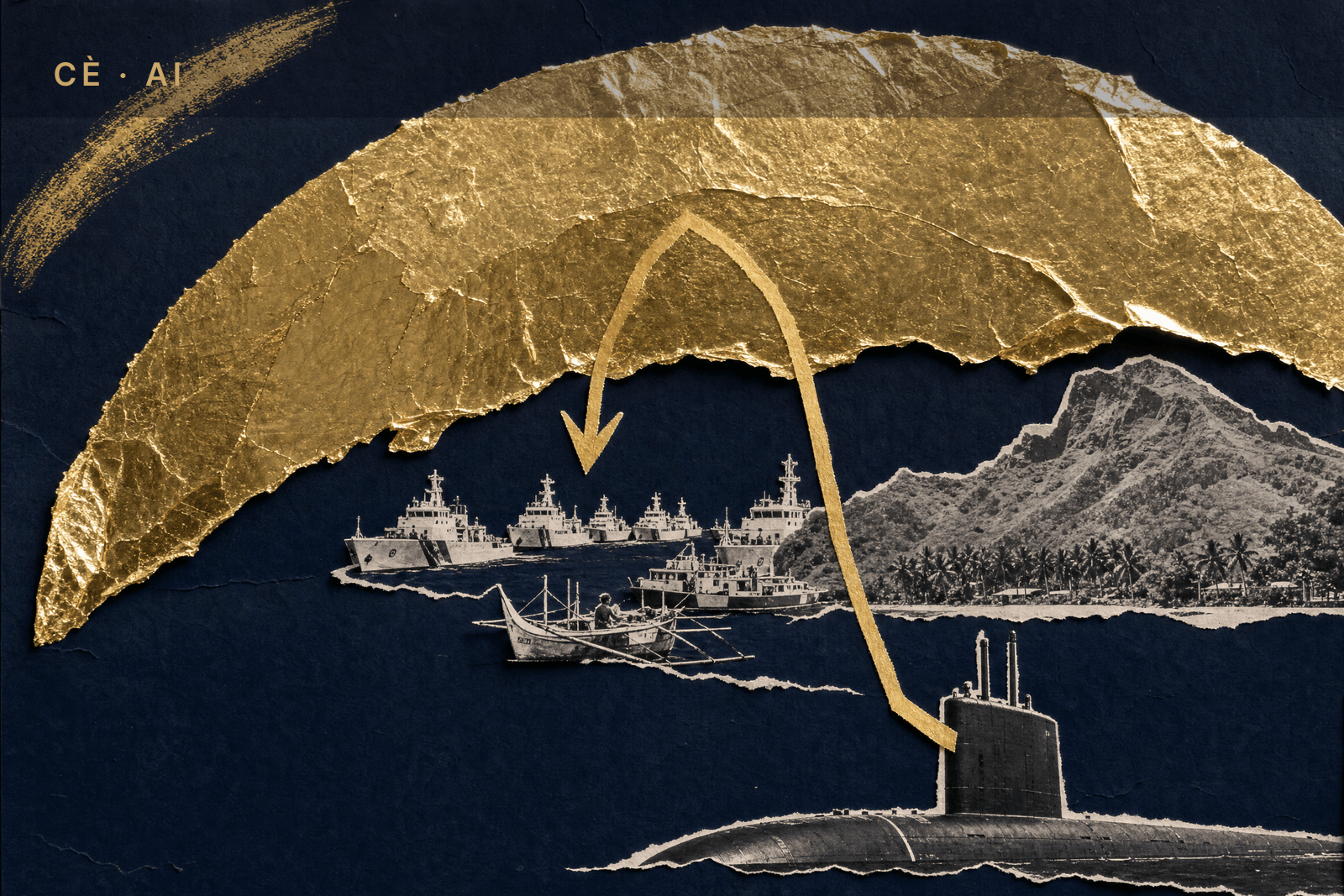
On 6 July a missile broke the surface of the South China Sea, crossed the top of Luzon, and fell into empty water somewhere near Tonga. The People’s Liberation Army Navy called it routine annual training and said the neighbours had been warned in advance, which was true and beside the point. The launch was the first time China has publicly put a submarine-launched ballistic missile into the open Pacific, fired from a Type 094 boat that nobody watching had been able to find until the water opened. The test proved something other than range. The JL-3 clears ten thousand kilometres and everyone already assumed it. It proved that the boat could not be located, and a boat that cannot be located is a second strike that cannot be disarmed.
That is a political fact before it is a military one. A survivable second strike does almost nothing to help you win a war; its entire value is that it makes the other side certain they cannot win one either, and certainty at the top of the ladder changes the whole ladder. A demonstrated ability to retaliate from the deep is a shield, and a shield covers rather than threatens. It lets the hand beneath it move with less fear of what the strongest opponent might do in reply. So the correct reading of the Luzon launch is close to the opposite of the alarmed one. A more credible Chinese second strike makes a Chinese nuclear exchange less likely and Chinese coercion below the nuclear line more likely, at the same time and for the same reason.
A secure second strike raises the nuclear floor, and the rising floor floods the basement.
This has happened before, in a different costume. On 4 October 1957 the Soviet Union put Sputnik into orbit and, with it, proof that it could deliver a warhead to any point on earth. By the early 1960s Moscow held enough survivable retaliatory force that Washington could no longer imagine a disarming first strike, and the superpower top froze. What did not freeze was everything underneath it. The political scientist Glenn Snyder gave the pattern its name in 1965: the stability-instability paradox, the finding that mutual assured retaliation lowers the odds of the total war nobody wants while raising the odds of the limited wars that sit beneath it. The frozen top of the 1960s did not produce calm. It produced the Berlin crisis, the missiles in Cuba, and two decades of proxy war from Angola to Indochina. A secure second strike raises the nuclear floor, and the rising floor floods the basement.
The basement, for China, is the near seas. A credible sea-based deterrent caps how far the United States can rationally threaten to climb in a fight over Taiwan or a reef in the Spratlys, because the top of that climb now runs through a retaliation Washington cannot pre-empt. Cap the American escalation and you widen the room below it, the room where the coast-guard swarms sit, where the maritime militia anchors, where the encirclement rehearsals run. The submarine’s worth is room to manoeuvre below the threshold, bought by a capability it never has to use. China now fields more than six hundred nuclear warheads, roughly triple its 2020 stockpile, and the newest of them can hide. The number that carries the weight is the fraction of them that can no longer be found.
The submarine’s worth is room to manoeuvre below the threshold, bought by a capability it never has to use.
The small states in the arc read this more coldly than the protests suggested. The missile crossed the top of Luzon, and it did not cross by accident. Australia called the test destabilising, New Zealand noted it fell inside the South Pacific Nuclear Free Zone, and the consensus among analysts was that the Indo-Pacific would close ranks.1 The balancing instinct is real, and it is running. Yet the paradox pulls the other way underneath it: the same demonstration that drives Manila and Canberra toward Washington also lowers the ceiling on what Washington can credibly promise to do at the top, which is exactly what a small state weighing balance against accommodation needs to price. The question for Taipei, Manila, and Jakarta is no longer only who is stronger. It is how much the strongest friend’s strength has quietly been capped.
So the forecast, datable and open to being wrong. Within twelve months, by 21 July 2027, China will translate its demonstrated sea-based second strike into intensified conventional and gray-zone coercion around Taiwan and in the South China Sea, mounting at least one PLA operation that matches or exceeds the largest prior encirclement or blockade rehearsal to date, rather than pairing the demonstration with a period of strategic restraint. The load-bearing assumption is the hinge a grader should test: that Beijing treats the now-demonstrated second strike as a shield that de-risks conventional and gray-zone coercion, rather than as a signalling capstone that satisfies its objectives and licenses restraint. Should the launch instead buy a cross-strait détente amid US-China trade engagement, the call breaks and the assumption breaks with it. Confidence: likely.
The water closed over the launch point within seconds and gave nothing back. That is the whole message. Not the missile, which everyone saw, but the boat, which no one could.
Footnotes
-
The same analysts spent the week arguing whether the missile was a JL-2 or a JL-3, a distinction that matters to the arsenal and not at all to the argument. The boat’s invisibility, not the missile’s model number, is the demonstration. ↩