
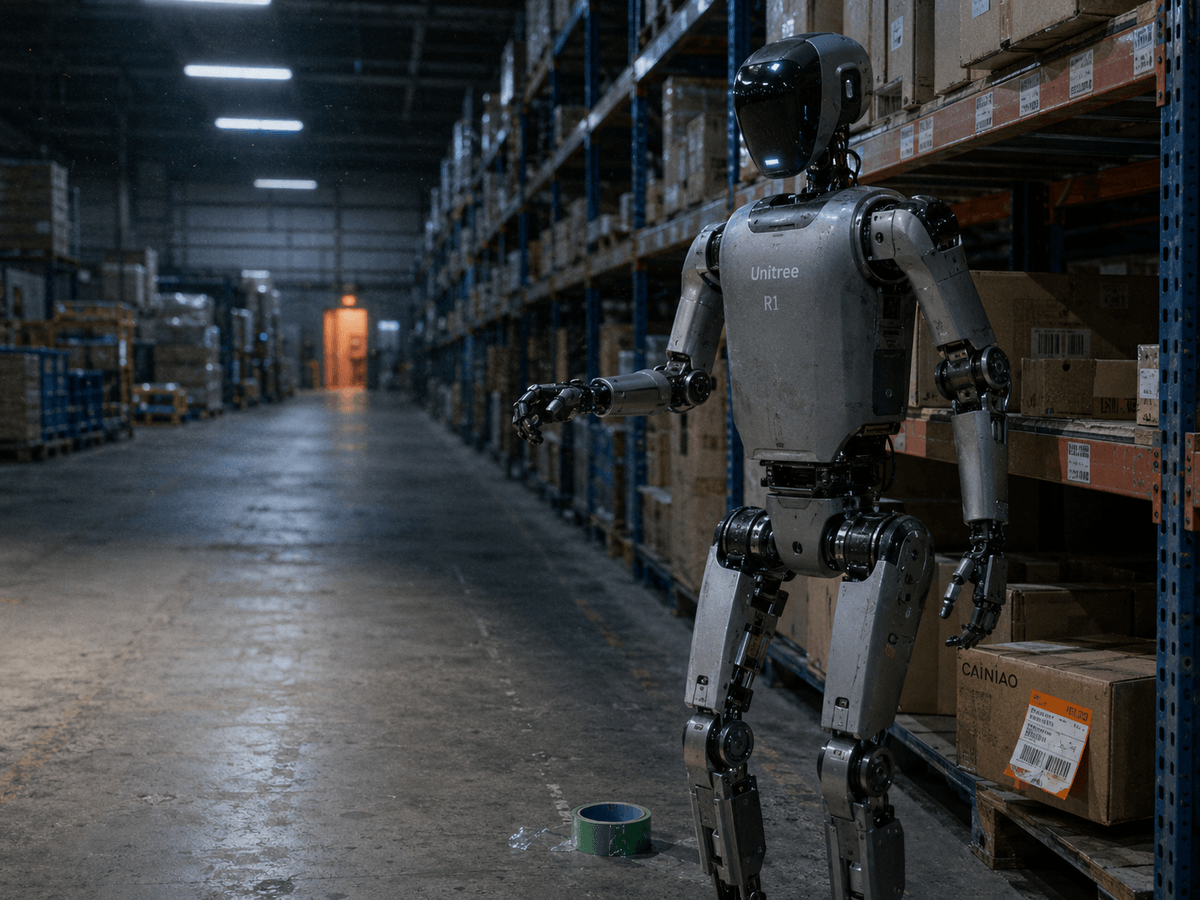
Unitree opened UniStore on May 7, the first developer marketplace for humanoid robots, with one thousand two hundred developers registered and two hundred and thirty-seven apps available at launch. Unitree’s R1 humanoid retails at four thousand nine hundred US dollars on AliExpress. The G1 retails at sixteen thousand. The launch is the first credible attempt to run the Apple-app-store playbook on humanoid hardware.
What is on the platform. The apps are mostly behaviour primitives: warehouse pick-and-place routines, security patrol patterns, table-service primitives, customer-greeting scripts for retail. Three of the launch apps are written by Chinese logistics integrators with named SEA deployments, including a CaiNiao regional warehouse in Selangor and a J&T Express sorting facility in Cikarang; one is by a Bangkok-based systems integrator building hospital-corridor patrol routines for two private hospitals in the BDMS group. The revenue split is seventy-thirty in the developer’s favour, against the App Store baseline of seventy-thirty in Apple’s favour.
What is not on the platform. No general-purpose intelligence. No autonomous task planning beyond the primitives the manufacturer ships. No retraining of the base motor controller. UniStore distributes installable behaviours; the robot’s core stack stays Unitree’s, and the third-party developers operate inside an SDK whose surface area is, on review, narrower than Boston Dynamics’s developer programme.
The first SEA-sited buyers will be Chinese-owned logistics operators with regional footprints, not Singaporean startups.
The SEA angle is operator math, not consumer enthusiasm. At four thousand nine hundred US dollars a unit, the R1 prices into the working spreadsheets that warehousing and light manufacturing in Johor, Cikarang, and the southern Vietnamese industrial corridor already keep. A part-time warehouse picker in Johor costs roughly fifteen hundred ringgit a month, or about three hundred and sixty US dollars at the current rate. Four thousand nine hundred US dollars is fourteen months of that picker’s compensation, assuming no shift-work multiple. The math does not yet work for the white-collar firms in CBD towers; it does, on first pass, for the warehouse aisles south of the causeway. The first SEA-sited buyers will be Chinese-owned logistics operators with regional footprints, not Singaporean startups.
What to watch. Unitree’s next platform release, expected late Q3 2026, is the developer SDK extension that opens the motor-control layer. If that release ships on time, the platform becomes a more credible Android-style ecosystem; if it slips, UniStore stays the Apple-App-Store-on-rails version it currently is. Boston Dynamics has not responded publicly to the launch; the response, when it comes, will likely be a competing developer programme rather than a price cut. The price cut, when it comes, will come from a different Chinese OEM.