
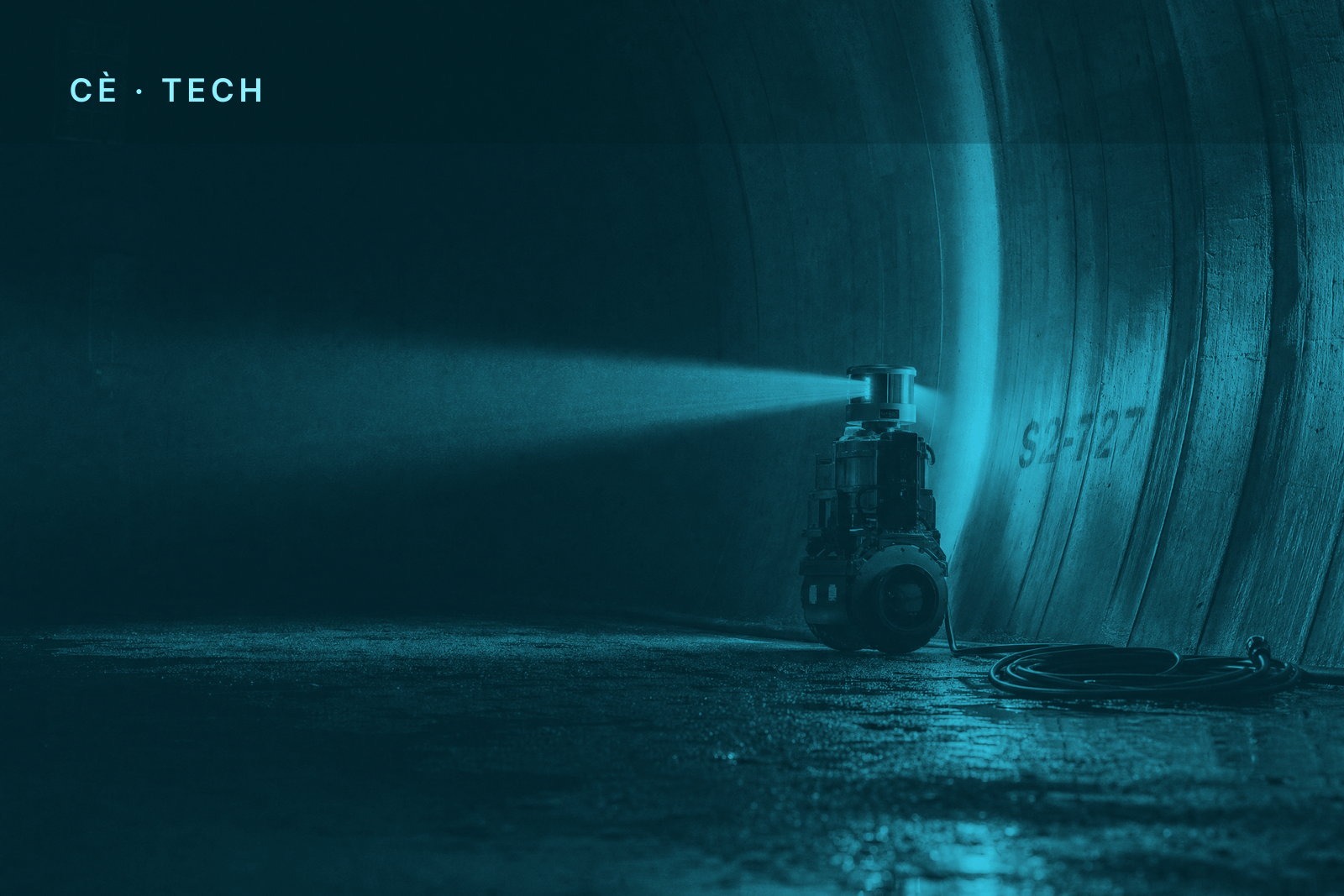
dConstruct closed a US$125 million Series A on 3 July, one of the largest robotics rounds Southeast Asia has recorded. While the region spent the season arguing about which chatbot to standardise on, the biggest AI cheque of the quarter went to a company that teaches machines to see in places a satellite cannot reach.
The company builds reality-capture, not conversation. Its d.ASH suite fuses 3D scanning into robots that can navigate GPS-denied environments: underground car parks, rail tunnels, refinery interiors, the inside of a half-built tower. The chief executive, Chinn Lim, has a client list that reads like the physical economy rather than the app economy, the Defence Science and Technology Agency, SBS Transit, JRE Ventures from the East Japan Railway group, and Softbank Robotics Singapore. A 42,000-square-metre headquarters at Punggol, dC Plus, is due for completion at the end of this year, with test floors for wheeled, quadruped and humanoid platforms. dConstruct came up through RoboNexus, the venture-building programme run under Singapore’s National Robotics Program with A*STAR, Enterprise Singapore and SGInnovate; its inaugural cohort, alongside LionsBot and Spinoff Robotics, has just graduated.
The moat lives in the years of scanning real basements, tunnels and rail tunnels, a corpus of captured space a competitor can promise but cannot download.
Here is why the unglamorous part is the whole point. Reality-capture for spaces with no satellite signal is deliberately boring, and boring is hard to copy from a blog post. The moat lives in the years of scanning real basements, tunnels and rail tunnels, a corpus of captured space a competitor can promise but cannot download. In a region that measures ambition in app screenshots, a business made of atoms is underrated precisely because it takes so long to fake.
The cohort is already exporting. LionsBot, run by Dylan Ng, now operates in more than forty countries with over 6,000 cleaning robots deployed; Spinoff Robotics, which builds tethered aerial robots for facade inspection, was acquired by the ASX-listed Nanoveu. Between them they have pushed into Asia, Europe, the United States and the Middle East, and the next RoboNexus intake is expected to open in March 2027. Singapore’s edge is the boring kind that compounds: a dense manufacturing base, the region’s busiest port, and a tolerance for precision work that pure software never demanded.
Set that against China and the stakes sharpen. Morgan Stanley now expects roughly 50,000 humanoid units shipped in China this year; Beijing has told industry to put 10,000 humanoids into real jobs by year-end. The Yangtze delta packs a full robotics supply chain inside a two-hour logistics radius, and smartphone suppliers such as Lens Technology and AAC are turning their cooling and structural expertise toward robot bodies.1 Singapore will not win on scale or unit cost, and the strategy quietly concedes both, aiming instead at the layer where a robot understands the room.
The public word for this is a hub. The private word is capex, and a five-year wait for the first clean line of profit.
The public word for this is a hub. The private word is capex, and a five-year wait for the first clean line of profit. A US$125 million round buys test floors and headcount, not next quarter’s cashflow, and robotics timelines are the opposite of the cashflow-first playbook most operators run. Respect the physical moat; that is different from cheering everyone into building robots.
The scanner keeps moving through the dark tunnel, mapping a room no phone can find, while the chatbots hold the light in the room upstairs.
Footnotes
-
One Chinese contender, Honor’s D1, ran a 21-kilometre half-marathon on a motor kept cool by cooling technology lifted straight from its phones. Scale, it turns out, has its own kind of party trick. ↩