
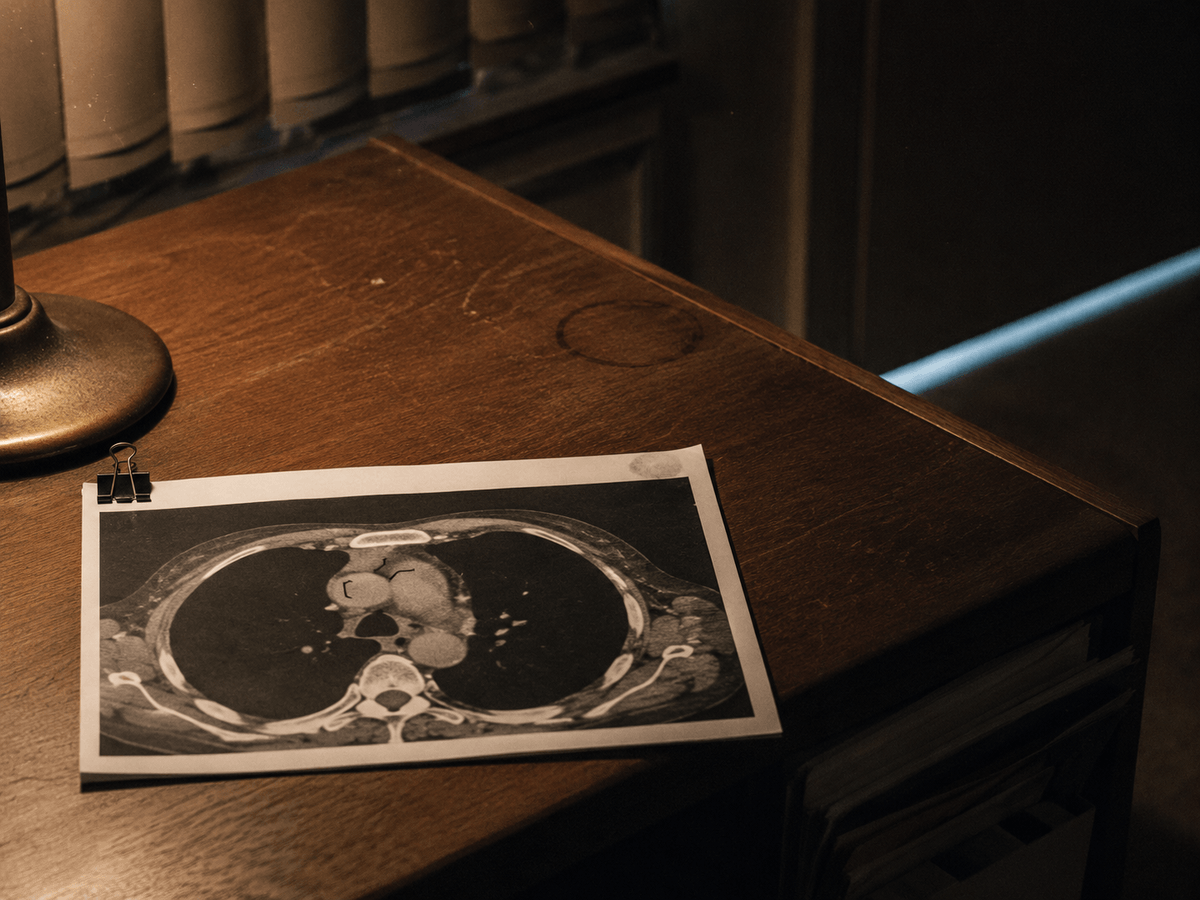
The Nature issue dated 18 March 2026 carried two papers from Hugo Aerts’s group at Mass General Brigham. Twenty-five thousand adults from a US lung-cancer screening trial. Two thousand five hundred more from the Framingham Heart Study. One thousand two hundred patients from a cancer immunotherapy registry. The same AI model scored each CT scan on the size, shape, and density of one organ.
The organ is the thymus. Every standard textbook through 2024 treated it as functionally retired after puberty. The new data say otherwise. Subjects in the highest thymic-health quintile recorded roughly 50 percent lower all-cause mortality, 63 percent lower cardiovascular death, and 36 percent lower lung-cancer incidence than the lowest. Among the immunotherapy cohort, the gap was 37 percent on cancer progression and 44 percent on death.
The score is not a thymic biopsy. It reads how fast the organ has been replaced by fat, an involution signal visible on a routine low-dose chest CT. Subjects with more preserved thymic tissue carried stronger T-cell renewal markers in serum. The evidence is observational across two large prospective cohorts and one disease registry. Level 2 by cè’s grading: large, replicated, predictive, but not yet interventional. Nobody has tested whether moving the marker moves the outcome.
The honest reading is that the score reflects the life the subject has already led, more than a target the subject can now hit.
The variables that correlated with poor thymic health were not surprises. Chronic systemic inflammation. Cigarette smoking. Elevated body weight, particularly visceral adiposity. The Aerts group flagged in the discussion section that nothing in the design tested whether intervening on any of those reversed thymic involution. The honest reading is that the score reflects the life the subject has already led, more than a target the subject can now hit.
For the regimens cè has been tracking, the practical implication is small. Subject A’s eight-hour feeding window and four weekly resistance sessions, Subject C’s PCSK9 inhibitor and aerobic block, were designed against cardiovascular endpoints with stronger published evidence than the thymic literature now carries. Whether either subject’s thymic score moved is unmeasured. None of the three Singapore principals in the May field note has had a thymic score read. Aerts’s lab has signalled the model will be open-sourced and packaged as an inference layer over routine CT, with no Asian-cohort validation done yet.
What the paper does change is the case for screening cadence. A principal undergoing the standard annual executive scan at Mount Elizabeth or Raffles Medical already has the input data sitting on a hospital server. The marginal cost of running an open-source thymic score over an existing low-dose chest CT is closer to zero than to the four-figure annual lift quoted by the Bay Area longevity clinics now positioning to sell it.[^1]
Subject B’s next chest CT is in week 28. cè will run the de-identified scan through the Aerts model when the model ships.
[^1]: Two of the three SF clinics that briefed cè in late April quoted between $4,800 and $7,200 a year for what they described as “thymic-age tracking.” The published Aerts pipeline does not yet exist as a service. The clinics are building marketing on top of a model that has not yet shipped.