
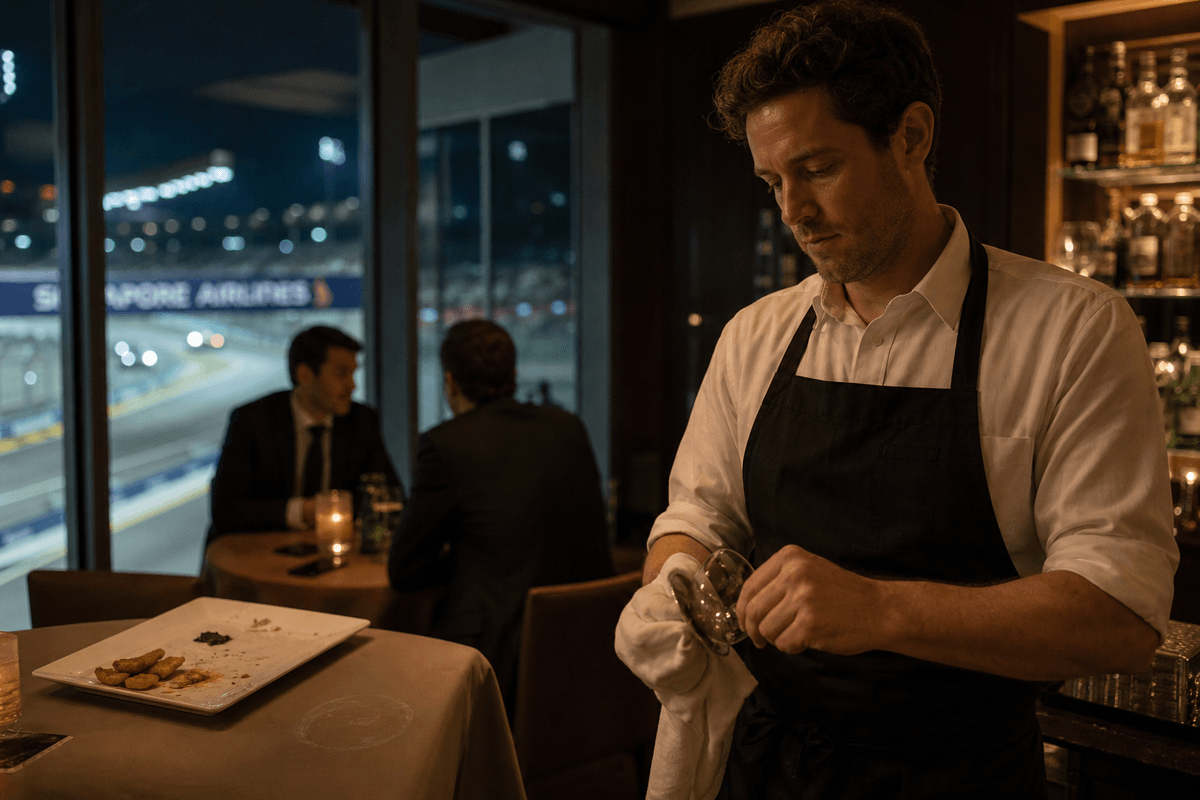
The Singapore Grand Prix is run at night, around the streets of the city, and is the only Formula 1 race on the calendar that finance professionals book a year in advance not because they like Formula 1 but because the corporate hospitality suites overlooking turn fourteen are, for one weekend in September, the most concentrated dealmaking environment in the region. The race is the cover story. The cover story has been the cover story for eighteen years.
This year’s edition, the eighteenth running of the race in Singapore, will run as the previous seventeen have, around what amounts to a working-finance-district circuit (the cars come down a road from a partner’s office to a coffee shop for which I am still owed a coffee) at a time of year when the regional principal class is mostly in town because it is the week the Bloomberg New Economy Forum used to be held, and which now in 2026 will be held a month later in Delhi instead, which means the September weekend has lost its companion conference and gained, by accident, a slightly higher-stakes set of suite conversations.
The race is the cover story. The cover story has been the cover story for eighteen years.
The race itself is well-organised, well-televised, and slightly absurd in its commitment to being treated as a sport. (The teams will tell you it is a sport. They are correct, technically, and beside the point.) The interesting fact about the night-race is that the cars do not slow down for the heat, the humidity, or the quirks of the street circuit; the drivers do, very slightly, in the second half of the race, which is the part that is most legible from the suites, after a certain amount of champagne has been distributed.
The pricing of the suites is the data the principal class pays attention to. A suite in a tower over turn fourteen has, in the most recent published rate card, climbed to roughly a quarter of a million Singapore dollars for the weekend, which is a number that contains roughly three implicit assumptions. (The first is that the suite is the room and not the seat. The second is that the corporate guest list is what is being bought. The third is that the host is willing to be in the room himself and not just rent it out, because the conversations in the room work differently when the host is present.) The number has approximately doubled in five years.
A reasonable observer might think this means Singapore Grand Prix hospitality is overpriced. A less reasonable observer might think it underpriced, given how much business is conducted in the suite over the weekend that would otherwise have required three flights. Neither observer is necessarily wrong; they are looking at different sides of a transaction in which the asset is access, the asset is paid for in time, and the time is denominated in suite-weekends.
What is changing, in 2026, is that the Bloomberg conference is no longer the bookend. The principals who flew in for both events will fly in for one. The Saturday-morning conversations that used to spill into a Monday-morning panel will now have to do their own work, on the suite, before the cars finish their seventy-second lap.
The race will, in any case, be excellent.